

On this page
Time to Full Resolution (TTR) measures the total elapsed time between when a customer opens a support ticket and when that ticket is finally closed, calculated as Avg TTR = Total resolution time ÷ Resolved tickets. Median B2B SaaS resolution time sits around 10-24 hours depending on priority — P1 incidents under 4 hours, P2/P3 24-72 hours — with the cross-channel industry benchmark spanning 12-48 hours (Help Scout, Geckoboard, 2024-2026). TTR is the back-of-the-funnel partner to first-response time and first contact resolution — together they form the support-velocity slice of a composite customer health score, predicting churn risk in any account whose tickets routinely breach SLA.
Note on the acronym: industry sources (Help Scout, Klaviyo, Gorgias, Atlassian) call this metric TTR (Time to Resolution) or MTTR (Mean Time to Resolution). We use TTR on this page to match that convention and to avoid colliding with TFR (Time to First Reply), which is a different metric covered in our sister post.
Benchmarks#
The "good value" for Time to Full Resolution depends on (a) ticket priority and (b) support channel. Concrete 2026 benchmarks below — these are the same numbers Google AI Overview cites today from Decagon, Medallia, Count.co, and Gorgias.
By priority tier (B2B SaaS)#
| Priority | Median resolution target | Maximum acceptable (SLA) |
|---|---|---|
| P1 — production-down / urgent | under 1 hour | 4 hours |
| P2 — major impact / workaround exists | under 8 business hours | 24 hours |
| P3 — minor / cosmetic | under 24 business hours | 72 hours |
| P4 — question / feature request | under 3 business days | 5 business days |
A composite customer health score should weight P1 breaches heavily and P3/P4 breaches lightly — a single P1 SLA miss is a stronger churn signal than a backlog of unanswered feature requests.
By channel / industry#
| Channel / industry | 2026 resolution-time benchmark |
|---|---|
| Live chat | under 10 minutes |
| Phone support | 5-10 minutes |
| E-commerce | 12-24 hours |
| B2B SaaS | 24-48 hours |
| Financial services | 24-72 hours |
| Healthcare / logistics | 48 hours - several days |
| Cross-industry average | 12-48 hours |
Sources: Help Scout 2024 TTR Benchmarks, Geckoboard KPI Examples, Medallia ART glossary, Decagon ART guide, Gorgias Resolution Time 2024.
How TTR feeds a composite customer health score#
TTR by itself is a lagging operations metric. As an input to a customer health score, it gets useful when you:
- Aggregate per-account, not per-ticket — a single slow ticket is noise; an account whose median TTR is 3× your SLA for the last 30 days is signal.
- Bucket by priority — drop P4 from the health-score calculation entirely; weight P1 most heavily.
- Pair with first response time and FCR — TTR alone can't tell you whether long resolutions came from agent under-staffing or genuinely complex tickets. Combined with first-reply latency and first-contact-resolution rate, the three metrics triangulate the type of friction.
- Cross-reference with CSAT and CES — TTR tells you how long support took; CSAT/CES tell you whether the customer felt it.
Gathering all five signals (TTR, first-reply, FCR, CSAT, CES) in one place — like RevOS's free Customer Health Score Template — is what turns ticketing data into churn-prevention triggers.
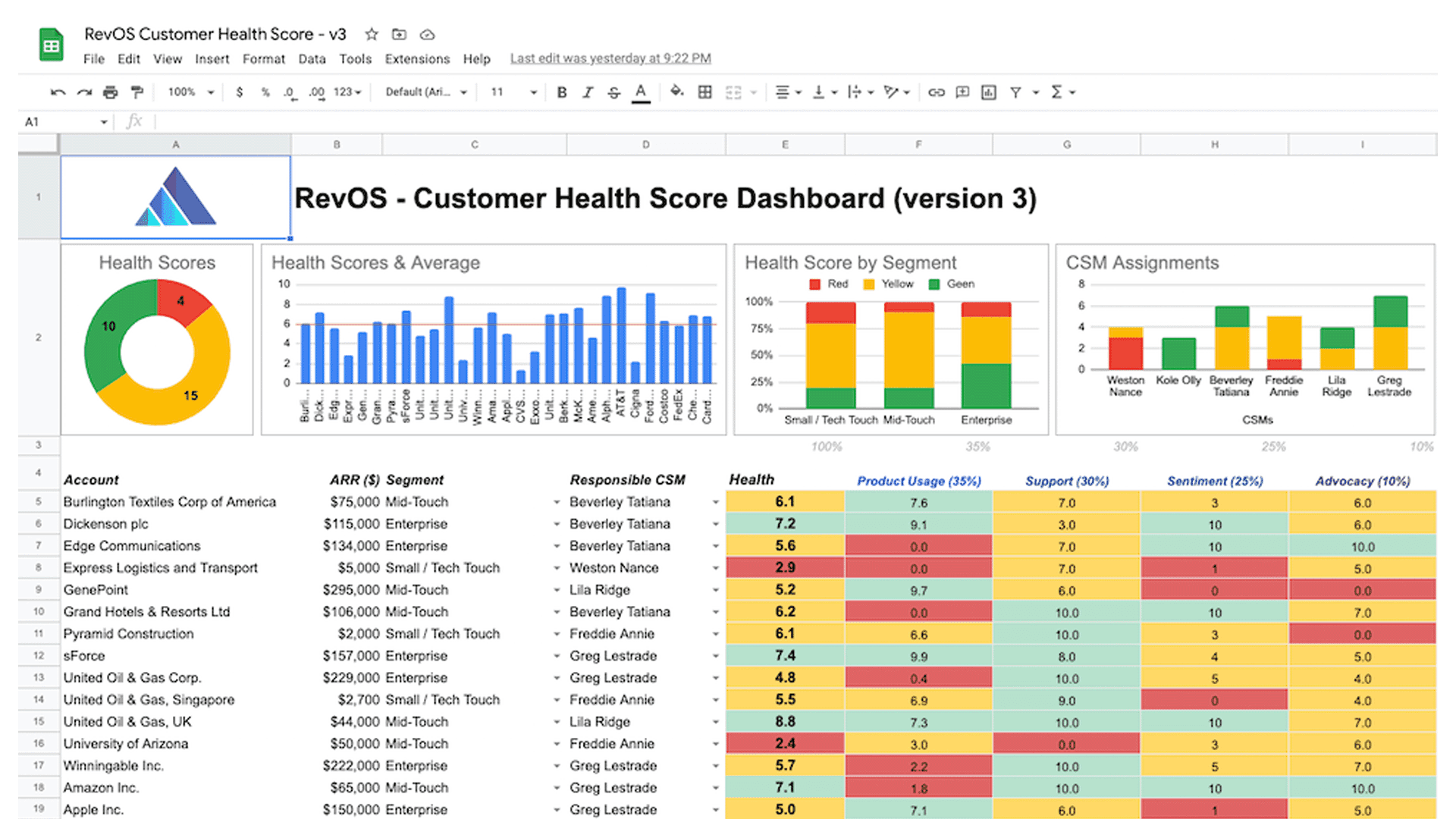
Download Free Customer Health Score Template
How to measure TTR consistently#
Three measurement choices that matter more than people realise:
- Calendar hours vs. business hours. Calendar hours reflect what the customer actually waited; business hours reflect internal productivity. Report both, but use business hours when comparing against SLAs and calendar hours when correlating with churn.
- Average vs. median. A few stuck tickets can drag the average up by hours. Use median for the headline number and average for trend analysis.
- Defining "resolved". The Zendesk-canonical timestamp is "the last time the ticket status was set to solved" — not "first marked solved", because re-opens count. Lock this definition before you start measuring.
Industry best practices#
- Technology / SaaS: tier support, route by ticket category, automate triage with macros and AI assists, expose status pages so urgent tickets self-prioritise.
- Healthcare: standardise resolution protocols, use EHR integrations to cut context-gathering time, leverage telemedicine for P3/P4.
- Retail / e-commerce: invest in agent training and product knowledge, deploy chatbots for top-10 FAQs, unify omnichannel context.
- Hospitality: centralise the support queue across properties, empower front-desk staff with the tools to resolve at first contact, capture P3/P4 feedback in batch.
- Financial services: segment by customer tier, build self-service for common compliance questions, use predictive analytics to surface issues before customers raise them.
Common challenges#
- Defining "resolution" for multi-faceted tickets that touch several systems.
- Data fragmentation across ticketing tools, CRM, chat, and phone — many teams measure TTR only inside Zendesk or Intercom and miss everything else.
- Variability between agents, channels, and ticket complexity makes a single benchmark misleading without segmentation.
- Prioritisation conflicts — a flood of P1 tickets from one account can degrade TTR for everyone else; weight by account, not by ticket volume.
FAQ#
What is time to resolution?#
Time to resolution (TTR), also called full resolution time or mean time to resolution (MTTR), is the average elapsed time between when a customer opens a support ticket and when that ticket is closed for the last time. It includes every back-and-forth, every escalation, and every re-open until the issue is finally solved.
How is average resolution time calculated?#
Average TTR = Total elapsed time for all resolved tickets ÷ Total number of resolved tickets. Decide upfront whether you're using calendar hours (what the customer waited) or business hours (internal productivity), and whether you're using the mean or the median — the median is more honest because a few stuck tickets won't skew it.
What is a good resolution time?#
It depends on priority and channel. A reasonable B2B SaaS benchmark is P1 under 1 hour, P2 under 8 business hours, P3 under 24 business hours, P4 under 3 business days. The cross-industry benchmark range is 12-48 hours; live chat should resolve in under 10 minutes, phone support in 5-10 minutes.
What's the difference between first response time and resolution time?#
First response time (FRT) is how long until the first human reply lands in the customer's inbox. Resolution time (TTR) is how long until the ticket is actually closed — which is almost always much longer. A team can have a 2-minute first-response time and a 48-hour resolution time; the two metrics measure different problems. See our deep-dive on Time to First Reply for how FRT works as a customer health signal in its own right.
How do you reduce ticket resolution time?#
The four highest-leverage moves: (1) deploy AI / chatbot triage on the top-10 highest-volume ticket categories, (2) build and maintain a knowledge base so customers self-serve P3/P4, (3) route by ticket category rather than round-robin so specialists see the right tickets, (4) measure and improve first contact resolution — every ticket resolved on first contact is a ticket whose TTR is its first-response time.
Does resolution time predict customer churn?#
Yes — when aggregated per-account and weighted by priority. A single slow ticket is noise. An account whose median TTR is consistently 2-3× your SLA over a 30-day window, especially on P1 / P2 tickets, is a strong leading indicator of churn. Drop TTR into your composite customer health score alongside CSAT, CES, FCR, and product engagement (DAU/MAU, WAU/MAU, license utilisation) to flag at-risk accounts before they cancel.
Related customer health metrics#
- First Contact Resolution (FCR)
- Time to First Reply (TFR)
- Customer Satisfaction Score (CSAT)
- Customer Effort Score (CES)
- Net Promoter Score (NPS)
- License Utilization
- DAU / MAU ratio
- WAU / MAU ratio
- Customer Health Score (pillar)
Want to stay up-to-date on the latest trends and insights? Check out our blog for expert analysis, practical tips, and inspiring success stories.
Frequently asked questions
- What is time to resolution?
- Time to resolution (TTR), also called full resolution time or mean time to resolution (MTTR), is the average elapsed time between when a customer opens a support ticket and when that ticket is closed for the last time. It includes every back-and-forth, every escalation, and every re-open until the issue is finally solved.
- How is average resolution time calculated?
- Average TTR = Total elapsed time for all resolved tickets ÷ Total number of resolved tickets . Decide upfront whether you're using calendar hours (what the customer waited) or business hours (internal productivity), and whether you're using the mean or the median — the median is more honest because a few stuck tickets won't skew it.
- What is a good resolution time?
- It depends on priority and channel. A reasonable B2B SaaS benchmark is P1 under 1 hour, P2 under 8 business hours, P3 under 24 business hours, P4 under 3 business days . The cross-industry benchmark range is 12-48 hours ; live chat should resolve in under 10 minutes, phone support in 5-10 minutes.
- What's the difference between first response time and resolution time?
- First response time (FRT) is how long until the first human reply lands in the customer's inbox. Resolution time (TTR) is how long until the ticket is actually closed — which is almost always much longer. A team can have a 2-minute first-response time and a 48-hour resolution time; the two metrics measure different problems. See our deep-dive on Time to First Reply for how FRT works as a customer health signal in its own right.
- How do you reduce ticket resolution time?
- The four highest-leverage moves: (1) deploy AI / chatbot triage on the top-10 highest-volume ticket categories, (2) build and maintain a knowledge base so customers self-serve P3/P4, (3) route by ticket category rather than round-robin so specialists see the right tickets, (4) measure and improve first contact resolution — every ticket resolved on first contact is a ticket whose TTR is its first-response time.
- Does resolution time predict customer churn?
- Yes — when aggregated per-account and weighted by priority. A single slow ticket is noise. An account whose median TTR is consistently 2-3× your SLA over a 30-day window , especially on P1 / P2 tickets, is a strong leading indicator of churn. Drop TTR into your composite customer health score alongside CSAT, CES, FCR, and product engagement (DAU/MAU, WAU/MAU, license utilisation) to flag at-risk accounts before they cancel.
Read more about revenue operations, growth strategies, and metrics in our blog and follow us on LinkedIn and Youtube.
All articles