
Agentic data engineering
Ship the data layer your AI needs — in an afternoon, without hiring a data engineer.
AI agents are only as good as the data underneath them — and getting that data right usually means hiring a data engineer. Agentic data engineering gets you there faster: describe what you need in plain language, and the agent builds it against your schema and your definitions. Best practices and batteries included.
30 minutes on your own schema. Hosted lakehouse, connectors, dbt + Cube.
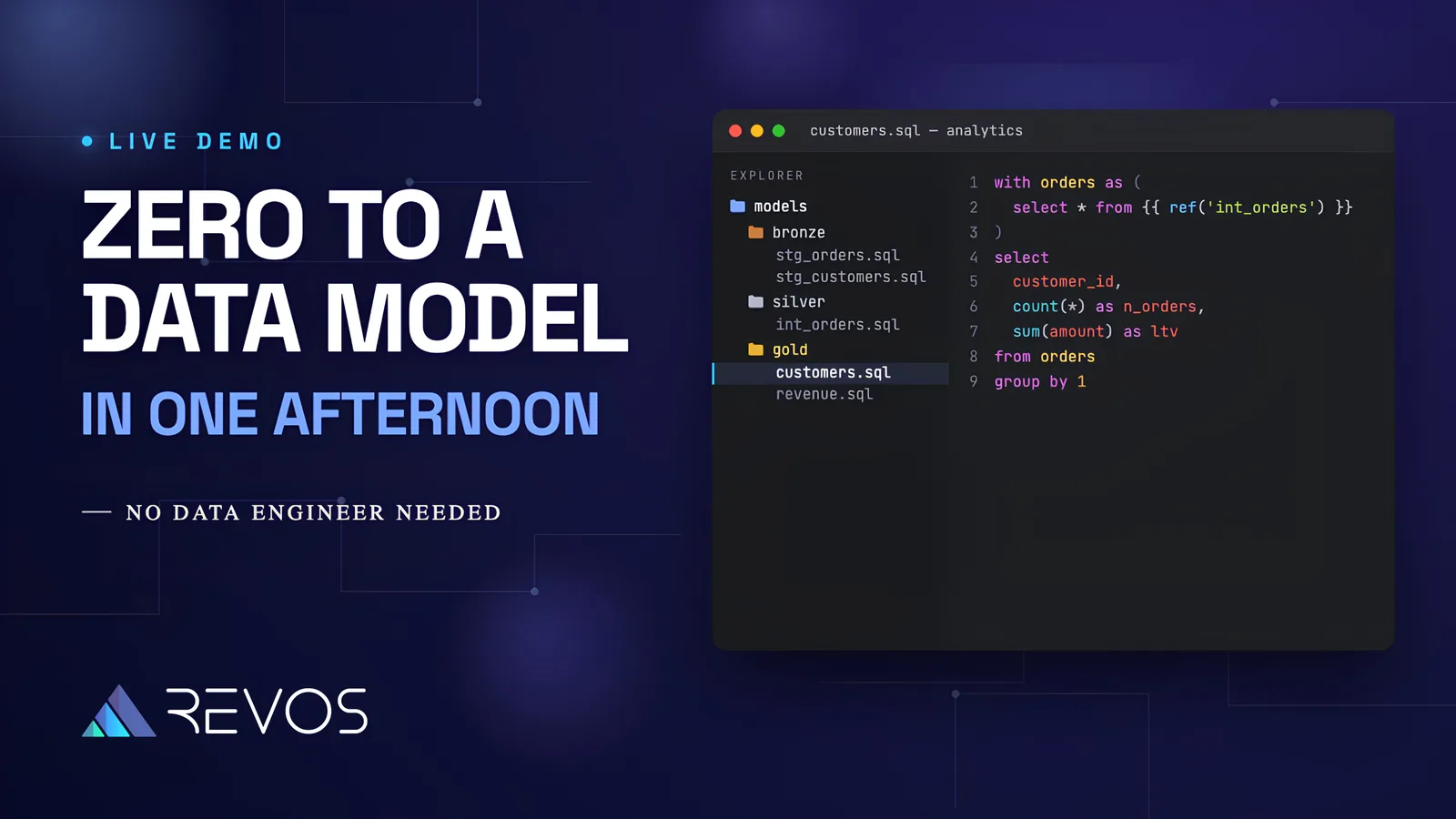
Watch the agent turn a plain-language ask into a dbt model and a governed semantic layer — ELT, transformations, and the metrics layer, built and validated.
How it works
Three steps. The third one runs itself.
Start a project in minutes.
Install the CLI, sign in from the browser, pick your org. One command (revos init) scaffolds the whole project — the environment, dbt, semantic overlays, credential wiring, and Claude Code's skills. Minutes, not days.
The agent builds it — grounded, not guessing.
Open the project and ask in plain language. Claude Code connects your sources and brings the data in (ETL/ELT), explores your lakehouse, writes the dbt transformations, and builds the semantic layer — working against your schema and your definitions, guided by curated skills that encode the way a senior data engineer would build it.
It ships like the rest of your code.
The result is the real thing — declarative, version-controlled, and wired into your own Git and CI/CD. These are production-grade data products that keep running in the background, so fresh, clean, verified, and validated data is always at your disposal. And you stay in control: scoped, time-bound access, with an audit trail on everything.
Why this matters: only ~5.2%of teams run agents in production today (Cleanlab 2025, n=1,837). The model isn't the bottleneck — the missing harness is. In Snowflake's own testing, a general-purpose model scored just 51% on their text-to-SQL evaluation; grounding the same task in a governed semantic model pushed accuracy past 90%. That's the harness RevOS ships pre-wired. Running it on our own work, our data-engineering and analytics delivery has come back 10× faster.
Copilot writes code; RevOS gives the agent the lineage, semantics, and policies to know which code is right. They compose.
See it on your own data this afternoon.
30 minutes on your own schema. Hosted lakehouse, connectors, dbt + Cube.
What you get
Everything the agent needs, pre-wired
Grounded in your schema, not a blank file.
The agent explores your live BigQuery lakehouse and queries the registered Cube semantic layer instead of guessing columns — the same grounding that took Snowflake's text-to-SQL evaluation from 51% past 90%.
Your data integrations, managed as code.
Sources and connections are declarative YAML, reconciled with revos apply / pull / diff — the same mental model as terraform apply. Versioned, reviewable, and rolled out the way you ship application code.
A working project in one command.
revos init scaffolds everything the agent needs from minute one — a ready-to-code Dev Container, a dbt medallion skeleton, semantic overlays, credentials wired to your lakehouse, and a sample dataset. From npm i to your first model: minutes, not days.
Claude Code arrives knowing your stack, not a blank prompt.
Every project ships with curated skills, so the agent can explore your BigQuery lakehouse, write dbt models with YAML data contracts, author the semantic layer, and render a model into a diagram for review — instead of guessing.
PII masked before it lands.
Stream mappers hash or redact sensitive fields at the integration boundary, before data ever reaches your lakehouse. Declarative and versioned alongside the connection that carries it.
It lives where you already work.
No new UI — the harness runs in a VS Code Dev Container, driven by Claude Code or the agent of your choice. MIT-licensed (@revos/cli, @revos/api-client), published with verified npm provenance, and Windows-tested in CI. Procurement-cleared.
A walkthrough of the RevOS Data Engineering Agent — AI-powered ELT, transformations, and the semantic layer.

What stood out to me most was the focus on combining AI with a well-defined data framework rather than just code generation. That feels like a meaningful differentiator. For teams that need a unified data layer but don't yet have a dedicated data engineer, this could significantly accelerate implementation and reduce complexity while still allowing for human oversight where needed.
FAQ
Questions you're probably asking
No. RevOS is built for technical operators — founders, RevOps leads, analysts, platform engineers — who can run a CLI, read YAML, and prompt an agent. The curated skills do the data-engineering work; you review the result.
Minutes. Install the CLI (npm i -g @revos/cli) and run revos init — it scaffolds the whole project (Dev Container, dbt, semantic overlays, credentials, and sample data), so you're prompting the agent the same afternoon.
A generic agent works from a blank file and guesses. RevOS gives it the harness — your lineage, semantics, and policies to know which answer is right, plus validation and CI/CD to catch a wrong one. Copilot writes code; RevOS gives the agent what it needs to know which code is right. They compose.
In your own BigQuery lakehouse — hosted by RevOS or your own GCP project. It stays in standard BigQuery tables you can query directly, never locked inside a proprietary store, and it's never used to train any models. You own the data; RevOS operates against it.
It ships configured for Claude Code, but the harness is agent-agnostic — any coding agent that reads its skills can drive it.
Plans start at €299/month for Startup, which includes the full set of agent capabilities, skills, connectors, and a 1 GB hosted BigQuery lakehouse. Growth and Enterprise scale from there, and every new account starts with a 14-day trial of the Growth plan. Book a demo and we'll find the right fit.
Today RevOS runs end to end on Google BigQuery with dbt and Cube. More data-lake providers are on the roadmap — if you need a different one, reach out and help us set the order we build them in.
The agent never touches production directly. It works in an isolated development environment, and its changes only reach production through your normal CI/CD pipeline — where automatic validations (dbt tests, primary-key and unique checks, data contracts) run before anything merges. On top of that, access is scoped and time-bound, every action lands in an immutable audit log, and production mutations like schema changes or deletions keep a human in the loop. Autonomy scales as trust accrues; it isn't the default.
It's a different shape — simpler, more open, and cheaper to start. Those are powerful but heavyweight platforms you assemble, staff, and pay enterprise contracts for. RevOS is AI-native: an AI coding agent operates the whole stack through a purpose-built harness, instead of AI bolted onto a legacy platform. It's built on open standards (dbt, Cube, BigQuery), so your data stays in standard tables you can query directly — no proprietary lock-in. And it starts at €299/month, not an enterprise contract. It runs on Google BigQuery today, with more data-lake providers in the works — if you'd like it on yours, just reach out.
Still have a question? Talk to us — or see how RevOS works for data engineers and the teams who don't have one.
Ready to build the data layer you've been waiting on?
30 minutes on your own schema. Hosted lakehouse, connectors, dbt + Cube.