

On this page
The WAU/MAU ratio is the share of monthly active users who also return within any 7-day window. Calculated as Weekly Active Users ÷ Monthly Active Users × 100, it measures product stickiness — how often engaged users actually come back. A healthy B2B SaaS ratio sits between 20–40%; consumer apps and high-engagement products often exceed 50%.
How to calculate WAU/MAU?#
This ratio is calculated by dividing the number of unique users who actively engage with a product or service over a week by the number of unique users who actively engage over a month. A higher WAU/MAU ratio indicates that a higher percentage of users are regularly engaging with the product or service, indicating a healthier and more engaged customer base.
What is a good WAU/MAU value?#
A good value for the WAU/MAU varies depending on the industry and type of product or service. Generally, a ratio of 0.3 to 0.5 is considered good, indicating that 30-50% of monthly active users are also active on a weekly basis. For example, if a company has 1,000 monthly active users, a WAU of 300-500 would be considered good. It is important to keep in mind that different industries and types of products/services may have different benchmarks for what constitutes a good WAU/MAU ratio, and that the ratio should also be considered in the context of overall business goals and metrics.
Challenges#
Measuring and controlling the WAU/MAU ratio can be challenging due to several factors:
- Data Accuracy: Ensuring that the data used to calculate the ratio is accurate and reliable can be a challenge, especially if the data is being collected from multiple sources.
- User Identification: Distinguishing unique users can be difficult, especially if users are accessing the product or service through multiple devices or using anonymous accounts.
- Seasonality: The WAU/MAU ratio can be affected by seasonal fluctuations in user engagement, making it difficult to accurately measure and control the metric.
- Changes in User Behavior: Changes in user behavior, such as new features or product updates, can impact the WAU/MAU ratio and make it difficult to control.
- Interpreting Results: Interpreting the results of the WAU/MAU ratio can be challenging, especially when considering the impact of external factors such as marketing campaigns or industry trends.
To effectively measure and control the WAU/MAU ratio, it is important to have clear definitions and processes for collecting and analyzing data, to regularly monitor the metric and adjust strategies as needed, and to consider the ratio in the context of other relevant business metrics.
Alternatives to WAU/MAU ratio#
There are several alternative metrics that can be used instead of, or in conjunction with, the WAU/MAU ratio to measure customer engagement and feed a composite customer health score:
- DAU/MAU (Daily Active Users to Monthly Active Users) ratio: Measures the percentage of monthly active users who engage with a product or service on a daily basis.
- Retention Rate: Measures the percentage of users who return to a product or service over a specific period of time.
- Churn Rate: Measures the rate at which users stop using a product or service.
- Lifetime Value (LTV): Measures the estimated revenue that a customer will generate for a business over the entire time they use the product or service.
- Net Promoter Score (NPS): Measures customer satisfaction and loyalty by asking users to rate their likelihood of recommending a product or service to others.
Each of these metrics provides a different perspective on customer engagement and health and can be used to complement or supplement the information provided by the WAU/MAU ratio. The best metric(s) to use will depend on the specific goals and needs of the business.
The Power of the WAU/MAU Ratio for Customer Success#
By tracking the WAU/MAU ratio, businesses can better understand and improve customer satisfaction. For example, if a business sees a drop in the WAU/MAU ratio, it can take steps to improve customer engagement and satisfaction by offering promotions or new features. On the other hand, if a business sees an increase in the WAU/MAU ratio, it can capitalize on customer satisfaction by offering additional products or services.
The Power of the WAU/MAU Ratio for Business#
The WAU/MAU ratio also provides valuable insights for businesses looking to grow. A high WAU/MAU ratio is a good indicator that a business's products or services are in demand, allowing for opportunities for growth and expansion. A low WAU/MAU ratio, on the other hand, may indicate that it's time for a business to reconsider its offerings or strategy.
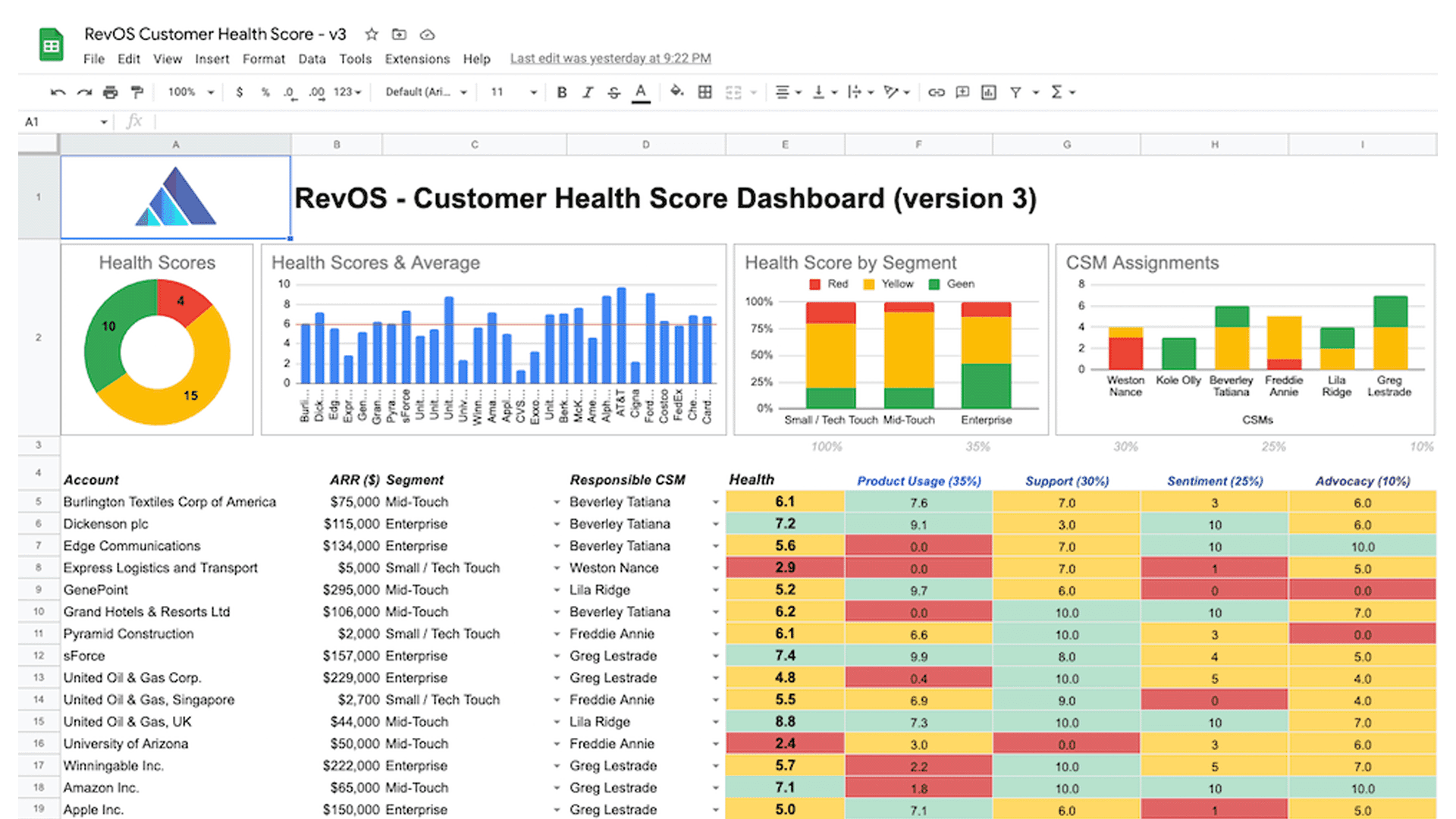
Want to put this in practice? Our Customer Health Score template is a free Google Sheets and Excel spreadsheet that tracks WAU/MAU alongside DAU/MAU, retention, churn, NPS, and the other engagement signals discussed above. Download it, plug in your data, and start scoring customer health in minutes — or skip the manual build with the RevOS Customer Health Score use case, which feeds the same signals straight from your CRM and product data.
FAQ#
What is WAU/MAU?#
WAU stands for Weekly Active Users and MAU for Monthly Active Users. The WAU/MAU ratio is the percentage of monthly users who also engage at least once per week. It's a stickiness metric used to gauge how habitual a product is for its user base.
What is a good WAU/MAU ratio?#
Benchmarks vary by category. For B2B SaaS, 20–40% is typical and 45%+ is high-performing. For consumer apps with daily-use intent, ratios above 50% are healthy. Asynchronous products like newsletters or scheduling tools naturally see lower ratios — focus on weekly retention there instead of raw stickiness.
How do you calculate WAU/MAU?#
WAU/MAU = (Weekly Active Users ÷ Monthly Active Users) × 100. WAU is the average of unique users active over the trailing 7 days, calculated daily and averaged across your reporting window. MAU is unique users active in the trailing 30 days.
What's the difference between WAU/MAU and DAU/MAU?#
Both measure stickiness but at different cadences. DAU/MAU answers "do users come back daily?" — relevant for messaging or news apps. WAU/MAU answers "do users come back weekly?" — better suited for B2B SaaS, content platforms, and tools used consistently but not daily.
When should I use WAU/MAU instead of DAU/MAU?#
Use WAU/MAU when your product has weekly-use intent rather than daily. B2B SaaS dashboards, project tools, newsletters, and reporting tools fit this pattern. DAU/MAU under-rewards these products by penalizing the days users are intentionally absent.
Why is WAU/MAU called the stickiness ratio?#
Because it measures what share of monthly users come back within the engagement window. A high ratio means your monthly users keep returning week after week — they're "sticking" to the product instead of cycling away after one visit per month.
Related customer health metrics#
- Net Promoter Score (NPS)
- Customer Satisfaction Score (CSAT)
- License Utilization
- DAU / MAU ratio
- Customer Effort Score (CES)
- First Contact Resolution (FCR)
- Time to Full Resolution (TFR)
- Time to First Reply (TFR)
Frequently asked questions
- What is WAU/MAU?
- WAU stands for Weekly Active Users and MAU for Monthly Active Users. The WAU/MAU ratio is the percentage of monthly users who also engage at least once per week. It's a stickiness metric used to gauge how habitual a product is for its user base.
- What is a good WAU/MAU ratio?
- Benchmarks vary by category. For B2B SaaS, 20–40% is typical and 45%+ is high-performing. For consumer apps with daily-use intent, ratios above 50% are healthy. Asynchronous products like newsletters or scheduling tools naturally see lower ratios — focus on weekly retention there instead of raw stickiness.
- How do you calculate WAU/MAU?
- WAU/MAU = (Weekly Active Users ÷ Monthly Active Users) × 100. WAU is the average of unique users active over the trailing 7 days, calculated daily and averaged across your reporting window. MAU is unique users active in the trailing 30 days.
- What's the difference between WAU/MAU and DAU/MAU?
- Both measure stickiness but at different cadences. DAU/MAU answers "do users come back daily?" — relevant for messaging or news apps. WAU/MAU answers "do users come back weekly?" — better suited for B2B SaaS, content platforms, and tools used consistently but not daily.
- When should I use WAU/MAU instead of DAU/MAU?
- Use WAU/MAU when your product has weekly-use intent rather than daily. B2B SaaS dashboards, project tools, newsletters, and reporting tools fit this pattern. DAU/MAU under-rewards these products by penalizing the days users are intentionally absent.
- Why is WAU/MAU called the stickiness ratio?
- Because it measures what share of monthly users come back within the engagement window. A high ratio means your monthly users keep returning week after week — they're "sticking" to the product instead of cycling away after one visit per month.
Read more about revenue operations, growth strategies, and metrics in our blog and follow us on LinkedIn and Youtube.
All articles