

On this page
First Contact Resolution (FCR) is a customer-support metric calculated as (Resolved on first contact ÷ Total contacts) × 100, where a "resolved" interaction needs no follow-up call, email, or escalation. The industry standard is 70-79% healthy, 80%+ world-class (Service Quality Measurement Group, cited by Zendesk and Sprinklr) — only about 5% of contact centers clear the 80% bar. FCR is also known as first call resolution; "contact" is the modern multi-channel framing covering phone, email, chat, and ticket. Paired with CSAT, NPS, CES, and time-to-full-resolution, FCR is one of the four front-line support inputs into a composite customer health score.
A high FCR means customers got their issue fixed the first time they reached out — no callback, no re-routing, no escalation. A low FCR means the opposite: customers are being bounced between agents, queues, or channels before their problem is solved. Either signal is one of the loudest, lowest-latency reads you can get on support health, and SQM Group's long-running benchmark research shows a tight 1-for-1 relationship between FCR and CSAT — every 1% improvement in FCR moves CSAT by roughly 1%, and every callback drops CSAT by ~15%.
Benchmarks#
The canonical industry benchmark, sourced from Service Quality Measurement Group (SQM) and quoted across Zendesk, Sprinklr, Qualtrics, and Salesforce, is 70-79% as the "good" range, 80%+ as world-class. Only ~5% of contact centers ever clear the 80% line.
Industry-specific 2026 benchmarks for B2B SaaS teams building a customer health score:
| Industry | 2026 FCR benchmark | Notes |
|---|---|---|
| Cross-industry (call center) | 70-79% | SQM Group industry standard |
| World-class (any industry) | 80%+ | ~5% of contact centers achieve this |
| B2B SaaS support | 70-78% | ticket-based; lower bound dragged by multi-step technical issues |
| E-commerce | 74-82% | high-volume, lower-complexity contacts |
| Telecom / utilities | 65-75% | most complex multi-team workflows |
| Financial services | 70-77% | compliance-bound, often requires escalation |
Sources: SQM Group 2026 benchmark, Zendesk FCR Guide 2026, Sprinklr First Contact Resolution Report.
A higher FCR is generally better, but achieving 100% is neither realistic nor necessarily desirable — some inquiries legitimately need escalation, multi-team coordination, or a follow-up after research. The right target is the upper end of your industry band, paired with a low repeat-contact rate and a stable time-to-full-resolution.
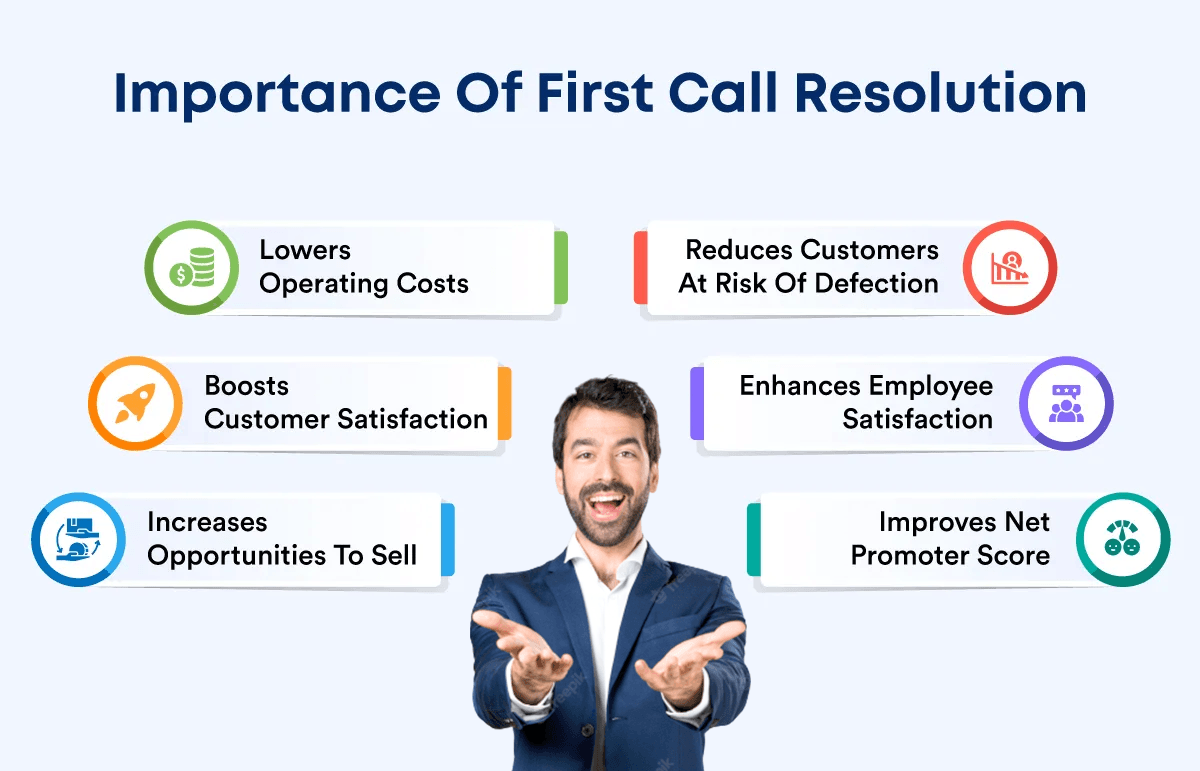
How to calculate FCR#
The formula is the same across every authoritative source (Zendesk, Salesforce, SQM Group, Qualtrics, Sprinklr, Atlassian):
FCR (%) = (Issues resolved on first contact ÷ Total contacts) × 100Two common variants matter:
- Gross FCR — every customer contact in the denominator. The honest, harsh number.
- Net FCR — only the contacts that could theoretically be solved in one go (excludes contacts the agent explicitly tagged as "requires escalation" or "billing approval pending"). The number you report to leadership when you want to look at agent performance specifically.
Pick one and stick with it — comparing your Gross number to a competitor's Net number is the most common way teams mislead themselves with this metric.
Three measurement methods, in increasing order of reliability:
- Post-contact surveys — ask the customer immediately after the interaction: "Was your issue fully resolved?". Subjective but captures customer perception, which is what actually drives the CSAT lift.
- Agent tagging — agents flag the ticket as resolved / not resolved at the end of the conversation. Cheap to instrument; agents have an incentive to over-report.
- Repeat-contact tracking — use the CRM or ACD system to detect whether the same customer contacts you again about the same issue within a 24-48 hour window. Most objective; doesn't require any survey overhead.
The best teams instrument all three, then triangulate.
Challenges#
Measuring and improving FCR presents several recurring challenges:
- Defining "initial contact". In an omnichannel world, a customer might start in chat, escalate to email, and land in a phone call — is that one contact or three? Set the definition explicitly: most B2B SaaS teams treat the linked ticket as the unit, not the channel-hop.
- Tracking customer interactions across channels. Requires a unified system of record. CRM-linked ticketing (Zendesk, Salesforce Service Cloud, Intercom) makes this tractable; bare-email support does not.
- Determining resolution. Resolution is inherently subjective from the customer's side. Always close the loop with a post-contact "Was this resolved?" check; don't rely solely on agent tagging.
- Data quality. Missing tags, mis-categorized contacts, or unrecorded channel-hops all inflate or deflate FCR in unpredictable directions. Audit your tagging discipline before you trust your FCR number.
How to improve FCR#
The improvement playbook is well-trodden — every major contact-center vendor has a version of it (Zendesk, Salesforce, Sprinklr, Atlassian, Calabrio). The five tactics that consistently move the number for B2B SaaS teams:
- Empower frontline agents. Give first-line reps the authority to issue refunds, approve returns, extend trials, or make policy exceptions up to a defined limit without supervisor approval. The single biggest driver of low FCR is "escalation culture" — every escalation is by definition not a first-contact resolution.
- Optimize the agent knowledge base. Keep an internal, searchable, constantly-updated knowledge base so agents don't have to put customers on hold to find accurate information. Connect it to the ticketing tool so agents see relevant articles inline.
- Use intent-based routing. AI-routing tools that analyze the customer's intent from the first message and route directly to the most-qualified agent (rather than round-robin or queue-based) reliably lift FCR by 5-15%.
- Run a regular re-opened-ticket review. Pull every ticket that required follow-up. Categorize by reason (knowledge gap, missing tool, policy bottleneck, broken handoff). Fix the top three reasons every quarter.
- Train cross-departmentally. Teach billing agents the basics of technical support, and vice versa. Most "I need to transfer you" moments come from artificial team boundaries, not real expertise boundaries.
How FCR feeds a customer health score#
FCR is one of the four front-line support-side inputs to a composite customer health score. The other three:
- CSAT — direct satisfaction signal per interaction.
- CES (customer effort score) — how hard it was to get the issue resolved.
- Time to first reply and time to full resolution — speed signals.
Together with the usage-side inputs (WAU/MAU, DAU/MAU, license utilization) and the commercial-side inputs (NPS, renewal-stage signals), they form a customer health score that flags at-risk accounts weeks or months before churn shows up in revenue numbers.
FCR is the loudest of the four support signals because of its 1-for-1 CSAT relationship (SQM Group): when FCR drops 5 points, expect CSAT to drop ~5 points within the same quarter and renewal risk to follow within two. This is why teams that build composite health scores almost always weight FCR more heavily than absolute ticket volume or first-reply time alone.
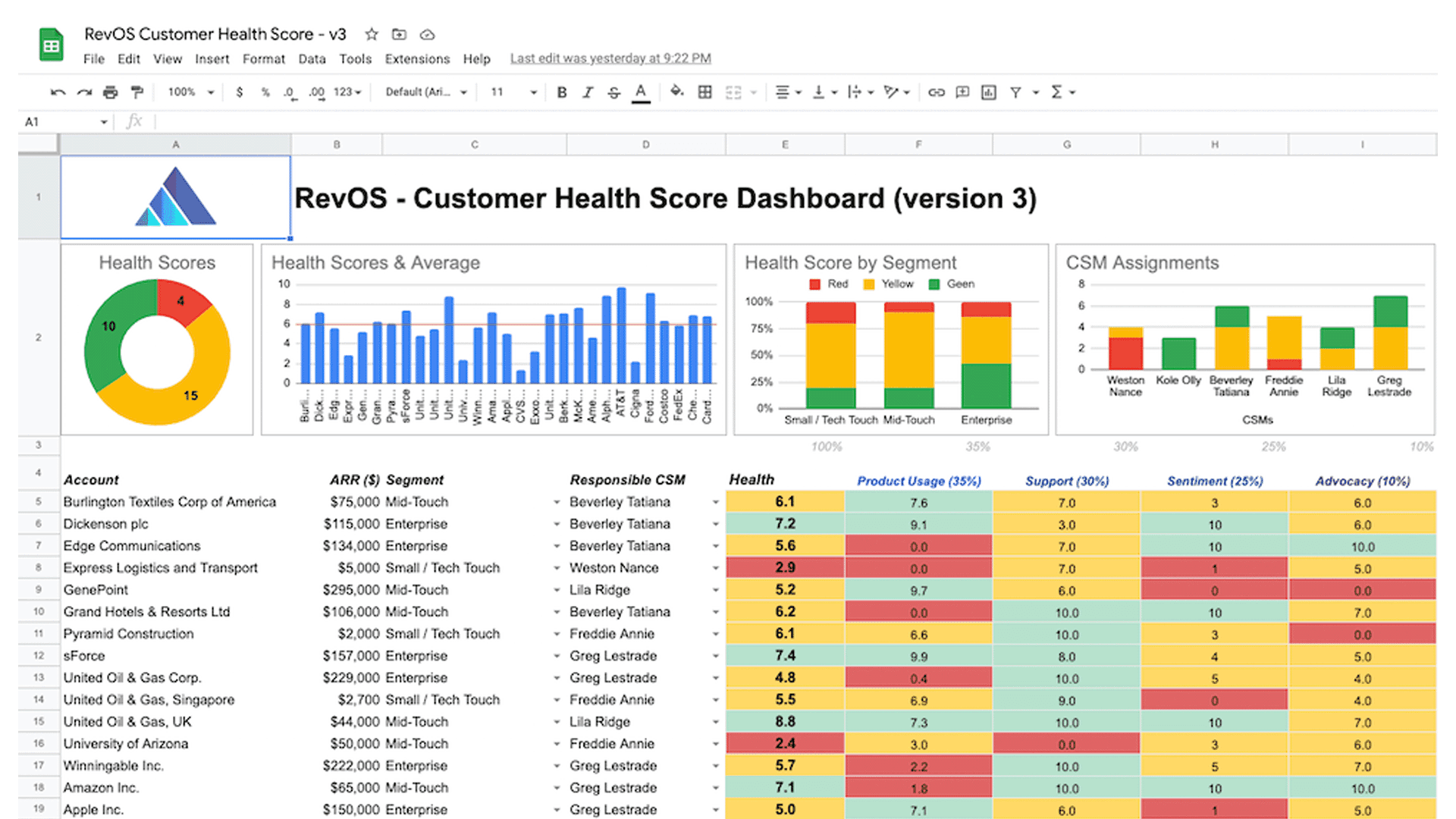
Download Free Template for Customer Health Scoring for Customer Success Managers and Sales Teams, unleashing valuable insights for business strategies, including churn risk, upsell opportunities, product development, and customer segmentation. Or skip the spreadsheet and have RevOS auto-calculate the same signals from your CRM — see the Customer Health Score use case.
FAQ#
What is first contact resolution?#
First contact resolution (FCR) — also known as first call resolution — is a customer-support metric that measures the percentage of customer inquiries fully resolved during the first interaction, with no follow-up call, email, escalation, or transfer required. It's calculated as (Issues resolved on first contact ÷ Total contacts) × 100.
How do you calculate FCR (first contact resolution)?#
Divide the number of contacts resolved on the first interaction by the total number of contacts in the same period, then multiply by 100. Example: if your support team handled 1,000 contacts last month and 740 were fully resolved on the first interaction, your FCR is 74%. Most teams report this monthly and segment by channel (phone, email, chat) and by issue type.
What is a good first contact resolution rate?#
The industry standard for a "good" FCR rate is 70-79%, based on Service Quality Measurement Group (SQM) benchmark research cited by Zendesk, Sprinklr, Qualtrics, and Salesforce. 80% or higher is considered world-class — only about 5% of contact centers achieve it. B2B SaaS support teams typically run in the 70-78% band.
What is the difference between FCR and first call resolution?#
Functionally they are the same metric — the only difference is channel framing. First call resolution is the original term from the voice-only contact-center era. First contact resolution is the modern omnichannel version that covers phone, email, chat, ticket, and any other support channel. Both are abbreviated FCR. Use "first contact resolution" if your support runs across more than one channel.
How does FCR affect customer health?#
FCR is one of the four support-side inputs into a composite customer health score, alongside CSAT, CES, and time-to-full-resolution. SQM Group research finds a near-1-for-1 relationship between FCR and CSAT — every 1% improvement in FCR moves CSAT by ~1%, and every callback drops CSAT by ~15%. When FCR slips, satisfaction and renewal risk follow within one to two quarters, which is why composite health scores typically weight FCR heavily.
How to improve first contact resolution?#
The five tactics with the most reliable impact for B2B SaaS support teams: (1) empower frontline agents to make refund / policy decisions up to a defined limit without escalation; (2) keep a searchable, current internal knowledge base linked to the ticketing tool; (3) use intent-based routing to send the contact directly to the most-qualified agent; (4) run a quarterly re-opened-ticket review to find and fix the top systemic failure modes; (5) train cross-departmentally so artificial team boundaries don't force unnecessary handoffs.
Related customer health metrics#
- Customer Satisfaction Score (CSAT)
- Net Promoter Score (NPS)
- Customer Effort Score (CES)
- Time to First Reply (TFR)
- Time to Full Resolution
- License Utilization
- WAU / MAU ratio
- DAU / MAU ratio
- Customer Health Score
Frequently asked questions
- What is first contact resolution?
- First contact resolution (FCR) — also known as first call resolution — is a customer-support metric that measures the percentage of customer inquiries fully resolved during the first interaction, with no follow-up call, email, escalation, or transfer required. It's calculated as (Issues resolved on first contact ÷ Total contacts) × 100 .
- How do you calculate FCR (first contact resolution)?
- Divide the number of contacts resolved on the first interaction by the total number of contacts in the same period, then multiply by 100. Example: if your support team handled 1,000 contacts last month and 740 were fully resolved on the first interaction, your FCR is 74%. Most teams report this monthly and segment by channel (phone, email, chat) and by issue type.
- What is a good first contact resolution rate?
- The industry standard for a "good" FCR rate is 70-79% , based on Service Quality Measurement Group (SQM) benchmark research cited by Zendesk, Sprinklr, Qualtrics, and Salesforce. 80% or higher is considered world-class — only about 5% of contact centers achieve it. B2B SaaS support teams typically run in the 70-78% band.
- What is the difference between FCR and first call resolution?
- Functionally they are the same metric — the only difference is channel framing. First call resolution is the original term from the voice-only contact-center era. First contact resolution is the modern omnichannel version that covers phone, email, chat, ticket, and any other support channel. Both are abbreviated FCR. Use "first contact resolution" if your support runs across more than one channel.
- How does FCR affect customer health?
- FCR is one of the four support-side inputs into a composite customer health score, alongside CSAT, CES, and time-to-full-resolution. SQM Group research finds a near-1-for-1 relationship between FCR and CSAT — every 1% improvement in FCR moves CSAT by ~1%, and every callback drops CSAT by ~15%. When FCR slips, satisfaction and renewal risk follow within one to two quarters, which is why composite health scores typically weight FCR heavily.
- How to improve first contact resolution?
- The five tactics with the most reliable impact for B2B SaaS support teams: (1) empower frontline agents to make refund / policy decisions up to a defined limit without escalation; (2) keep a searchable, current internal knowledge base linked to the ticketing tool; (3) use intent-based routing to send the contact directly to the most-qualified agent; (4) run a quarterly re-opened-ticket review to find and fix the top systemic failure modes; (5) train cross-departmentally so artificial team boundaries don't force unnecessary handoffs.
Read more about revenue operations, growth strategies, and metrics in our blog and follow us on LinkedIn and Youtube.
All articles