

On this page
Net Promoter Score (NPS) is a single-question customer-loyalty metric calculated as NPS = % Promoters − % Detractors on a 0-10 "How likely are you to recommend this product to a friend or colleague?" survey. Scores run from −100 to +100, with 30-50 considered strong, 50+ excellent, and 70+ world-class; in B2B SaaS the median sits around 30-40, though enterprise SaaS brands frequently exceed 60. NPS was developed by Fred Reichheld at Bain & Company in 2003 and remains the most widely-used customer loyalty metric in customer health scoring — usually as one of three or four signals alongside CSAT, retention, and product engagement.
NPS benchmarks (2026)#
What counts as "good" depends on your industry and customer segment. Reading the SERP, the cross-industry benchmark range cited by Bain, Qualtrics, SurveyMonkey, Medallia, Retently, and Survicate in 2026 looks like this:
| Score range | Interpretation | Notes |
|---|---|---|
| −100 to 0 | Needs improvement | More detractors than promoters; treat as a churn signal. |
| 0 to 30 | Good | Healthy baseline for most consumer products. |
| 30 to 50 | Great / strong | Standard target for established B2B SaaS. |
| 50 to 70 | Excellent | Top quartile in most industries; rarely sustained without strong CX investment. |
| 70 to 100 | World-class | Sustainable only for brands with an exceptional product or community moat (Apple, Costco, Tesla in their best years). |
For B2B SaaS specifically, public benchmark studies put the 2026 median around 30-40, with leading vendors landing 50-70. If you sell to an enterprise customer base measured in tens or hundreds of accounts (not thousands of seats), the small-N variance is huge — a single detractor on a 20-response quarter can swing the score 5-10 points — so trend the metric across rolling quarters rather than reading a single snapshot.
How NPS is calculated#
NPS is measured with a single question:
"On a scale of 0-10, how likely are you to recommend [Brand/Product] to a friend or colleague?"
Responses are bucketed into three groups:
- Promoters (score 9-10) — loyal enthusiasts who refer others and drive growth.
- Passives (score 7-8) — satisfied but unenthusiastic; vulnerable to competitor offers.
- Detractors (score 0-6) — unhappy customers; sources of churn and negative word-of-mouth.
The formula:
NPS = (% of Promoters) − (% of Detractors)Passives are intentionally excluded from the math. They count toward the response total (and the percentages) but don't move the score. A common implementation mistake is including the average of passive scores in some weighted way; the canonical Reichheld definition is the simple subtraction above.
Why NPS works (and the limits of one number)#
The reason NPS got adopted so widely is that it is simple to understand, simple to track over time, and directly tied to revenue growth. Reichheld's original research at Bain found that companies with sustained high NPS scores grow faster than competitors in the same industry. A high score signals that you're delivering an experience worth recommending — which in B2B SaaS translates into expansion, multi-year renewals, and referral pipeline.
That said, a single number is a starting point, not a system. NPS is most useful when paired with:
- Open-ended follow-up questions — "What's the main reason for your score?" turns NPS from a metric into actionable feedback. Without follow-ups, you have a number and no idea why.
- Account-level segmentation — NPS for your top 20% of customers by ARR tells a very different story than NPS for your long tail.
- Trend lines, not snapshots — quarter-over-quarter movement matters more than any single reading, especially for B2B SaaS where the response base is small. That trend line, not the latest score, is what belongs in the KPI block of a customer-facing QBR agenda.
Challenges with NPS#
Treating NPS as a standalone metric runs into a few well-known issues:
- Inconsistency in collection. Surveying via different channels (in-app, email, post-meeting) at different times produces non-comparable data. Pick a cadence and a delivery channel and stick with them long enough to build a baseline (at least two quarters).
- Response bias. Self-reported satisfaction skews positive for delighted customers and negative for frustrated ones. The middle of your customer base is under-represented. Counter this with high response rates (>30% is reasonable in B2B SaaS) and follow-up sampling of non-responders.
- Limited data per response. A single 0-10 answer doesn't explain why. Pair every NPS survey with at least one open-ended question.
- Lack of actionability. A score of 42 is not a to-do list. Slice the data by account segment, contract size, and tenure to find the actual pattern — the score itself is a smoke detector, not a fire-fighting plan.
- Small-N variance in B2B. If your customer base is 50 accounts, every responder is ±2 points worth of NPS. Don't over-interpret quarter-to-quarter wobble; trend it instead.
The standard countermeasure is to make NPS one of three or four signals in a composite customer health score — alongside product engagement (DAU/MAU, WAU/MAU, license utilization), support load (first contact resolution, time to first reply), and direct satisfaction signals (CSAT, CES).
When to use NPS vs CSAT vs CES#
| Metric | Question shape | Best for | Cadence |
|---|---|---|---|
| NPS | "How likely to recommend?" (0-10) | Long-term loyalty, brand strength, growth signal | Quarterly |
| CSAT | "How satisfied with this experience?" (1-5 / 1-7) | Specific touchpoint (after a ticket, onboarding, feature) | Transactional |
| CES | "How easy was it to get your issue resolved?" (1-5 / 1-7) | Support and service-friction signals | Transactional / post-interaction |
The three are complementary, not competitive. NPS tells you whether the relationship is healthy; CSAT and CES tell you whether the last interaction was. Most B2B SaaS health scores use at least two of them.
Alternatives to NPS#
If NPS doesn't fit your team — or you want supporting metrics — these are the most common alternatives:
- Customer Satisfaction Score (CSAT) — overall satisfaction on a 1-5 or 1-7 scale, typically transactional (after a specific interaction).
- Customer Effort Score (CES) — how much effort the customer had to spend to get a problem solved, on a 1-5 or 1-7 scale.
- Customer Retention Rate (CRR) — % of customers who stay over a defined period. The hardest metric to game but the longest to measure.
- Net Revenue Retention (NRR) — for B2B SaaS, the dollar-weighted version of retention (and arguably the single most important growth metric for a sub-$50M ARR SaaS).
- Repeat Purchase Rate (RPR) — for e-commerce and transactional businesses, the % of customers who buy again in a given window.
FAQ#
How is a Net Promoter Score calculated?#
Subtract the percentage of Detractors (responses of 0-6) from the percentage of Promoters (responses of 9-10). Passives (7-8) count toward the response base but aren't part of the score. Example: 100 responses, 50 Promoters, 30 Passives, 20 Detractors → NPS = 50% − 20% = +30.
What is a good NPS score?#
The cross-industry benchmark is 30-50 strong, 50+ excellent, 70+ world-class. For B2B SaaS the typical median is 30-40 in 2026, with leading enterprise vendors reaching 50-70. For consumer brands the bar is higher: Apple, Costco, and Tesla have hit 80+ in their best years.
Should the NPS scale be 0-10 or 1-10?#
The canonical Reichheld definition uses a 0-10 scale, not 1-10. Using 1-10 makes scores incomparable to other companies' published benchmarks and breaks the standard category boundaries (0-6 detractors, 7-8 passives, 9-10 promoters). Stick with 0-10.
What are the three NPS categories?#
Promoters (9-10) are loyal enthusiasts who recommend you. Passives (7-8) are satisfied but unenthusiastic and at risk of switching to a competitor with a better offer. Detractors (0-6) are unhappy customers who can damage your brand and are statistically the highest-churn-risk segment.
How often should you measure NPS?#
Quarterly is the standard for relationship NPS (the long-term loyalty signal), with optional transactional NPS triggered after specific events like onboarding completion or a major support resolution. Monthly is usually too noisy for B2B SaaS with small customer bases; annual misses too much variance to drive action.
When should you use NPS vs CSAT vs CES?#
Use NPS quarterly as a relationship-level health signal — it predicts long-term loyalty and revenue growth. Use CSAT for transactional moments (post-onboarding, post-launch). Use CES specifically for support and service interactions where you're optimizing friction. Most mature B2B SaaS programs run at least two of the three in parallel.
What's the NPS formula in plain terms?#
NPS = % Promoters − % Detractors. That's the entire formula. If 60% of responders are Promoters and 10% are Detractors, your NPS is +50. Passives are ignored in the math. Scores range from −100 (everyone is a Detractor) to +100 (everyone is a Promoter).
Related customer health metrics#
- Customer Satisfaction Score (CSAT)
- Customer Effort Score (CES)
- License Utilization
- DAU / MAU ratio
- WAU / MAU ratio
- First Contact Resolution (FCR)
- Time to Full Resolution (TFR)
- Time to First Reply (TFR)
Build your customer health score#
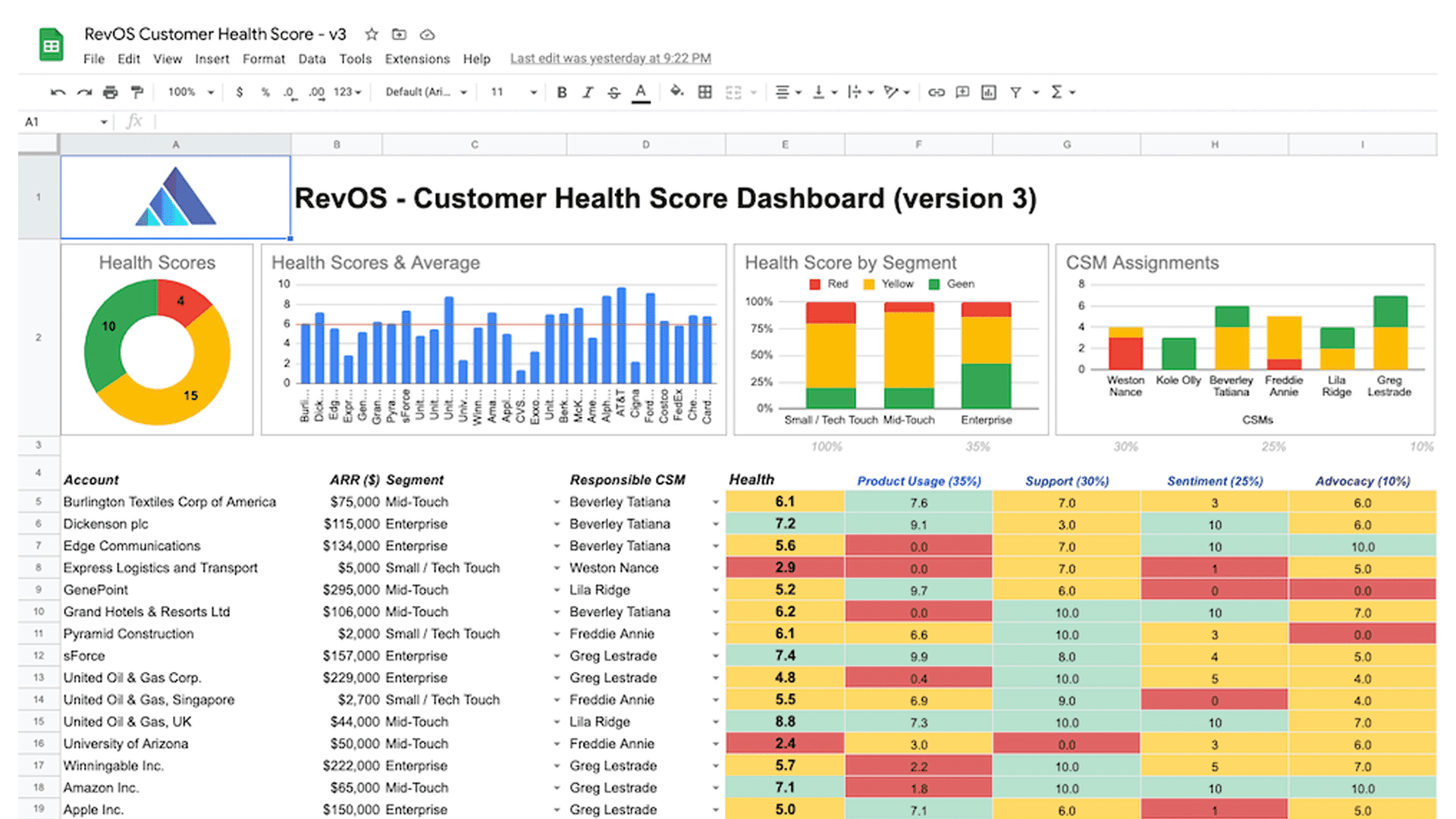
NPS is one of the strongest single signals you can measure — but its real power shows up when it's combined with product engagement, support load, and revenue retention into a composite health score that flags at-risk accounts before they churn.
For the full framework — composite scoring model, weights, and how every metric we cover on this blog fits in — see the Customer Health Score guide.
Frequently asked questions
- How is a Net Promoter Score calculated?
- Subtract the percentage of Detractors (responses of 0-6) from the percentage of Promoters (responses of 9-10). Passives (7-8) count toward the response base but aren't part of the score. Example: 100 responses, 50 Promoters, 30 Passives, 20 Detractors → NPS = 50% − 20% = +30 .
- What is a good NPS score?
- The cross-industry benchmark is 30-50 strong, 50+ excellent, 70+ world-class . For B2B SaaS the typical median is 30-40 in 2026 , with leading enterprise vendors reaching 50-70. For consumer brands the bar is higher: Apple, Costco, and Tesla have hit 80+ in their best years.
- Should the NPS scale be 0-10 or 1-10?
- The canonical Reichheld definition uses a 0-10 scale , not 1-10. Using 1-10 makes scores incomparable to other companies' published benchmarks and breaks the standard category boundaries (0-6 detractors, 7-8 passives, 9-10 promoters). Stick with 0-10.
- What are the three NPS categories?
- Promoters (9-10) are loyal enthusiasts who recommend you. Passives (7-8) are satisfied but unenthusiastic and at risk of switching to a competitor with a better offer. Detractors (0-6) are unhappy customers who can damage your brand and are statistically the highest-churn-risk segment.
- How often should you measure NPS?
- Quarterly is the standard for relationship NPS (the long-term loyalty signal), with optional transactional NPS triggered after specific events like onboarding completion or a major support resolution. Monthly is usually too noisy for B2B SaaS with small customer bases; annual misses too much variance to drive action.
- When should you use NPS vs CSAT vs CES?
- Use NPS quarterly as a relationship-level health signal — it predicts long-term loyalty and revenue growth. Use CSAT for transactional moments (post-onboarding, post-launch). Use CES specifically for support and service interactions where you're optimizing friction. Most mature B2B SaaS programs run at least two of the three in parallel.
- What's the NPS formula in plain terms?
- NPS = % Promoters − % Detractors . That's the entire formula. If 60% of responders are Promoters and 10% are Detractors, your NPS is +50 . Passives are ignored in the math. Scores range from −100 (everyone is a Detractor) to +100 (everyone is a Promoter).
Read more about revenue operations, growth strategies, and metrics in our blog and follow us on LinkedIn and Youtube.
All articles