

On this page
- What is a composite semantic layer?
- Why is one universal semantic layer so hard to build?
- How is a composite semantic layer different from a universal semantic layer?
- What is the Open Semantic Interchange (OSI)?
- Do AI agents need a semantic layer?
- What is the difference between a semantic layer and a context layer?
- What has Gartner said publicly, and what hasn't it?
- How do you start with a composite semantic layer?
A composite semantic layer is an architecture, named by Gartner, that coordinates the semantic models a company already has so they share one consistent business meaning. A universal semantic layer, by contrast, is a single model that every tool reads.
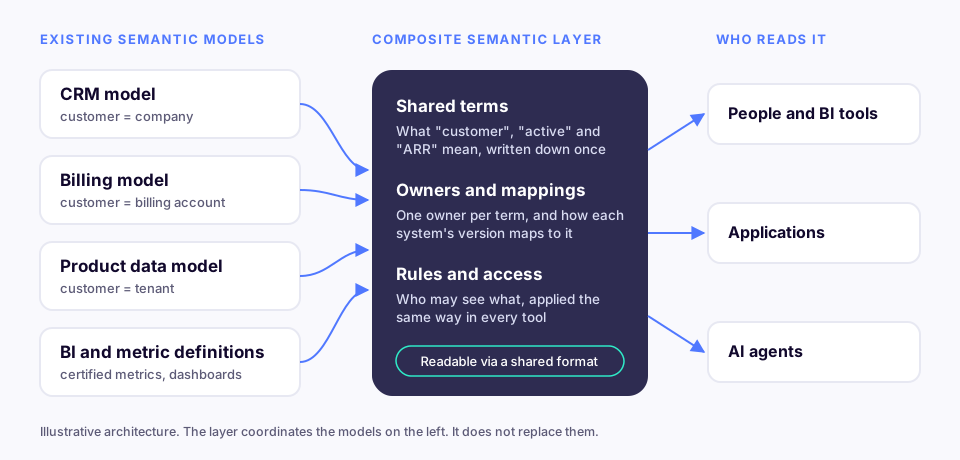
Here is why the difference matters. Ask three systems what a "customer" is and you get three answers. Your CRM says a company. Your billing tool says an account. Your product database says a tenant, which is one customer's workspace. A person can usually tell which one is meant. An AI agent usually cannot. This guide explains how a composite layer closes that gap, and where the Open Semantic Interchange (OSI) fits in.

What is a composite semantic layer?#
A composite semantic layer (CSL) coordinates the semantic models you already have, such as CRM, finance, product and business intelligence (BI) definitions, so they share one consistent business meaning. It maps them to each other instead of replacing them. Everyone who reads it then gets the same answer to the same question.
If "semantic layer" is new to you, our guide to what a semantic layer is covers the basics. In short, it is a shared definition of your business terms and metrics that sits between raw data and the tools that read it. The composite part is about what happens when you have more than one.
The term comes from Gartner. Its February 2026 research note, "Top Trends in D&A for 2026: Making Composite Semantic Layers Interoperable", is paywalled. We have only read its public summary, so this post sticks to that and to Gartner's press releases.
The summary says a single, universal semantic layer has stayed elusive. So data and analytics leaders are moving to a composite one. It coordinates the different semantic models and definitions a company has (Gartner calls them "semantically driven artifacts"). The aim is to close the "context gap", which is the distance between what the data says and what the business means. It also cuts down analytical silos and keeps business logic consistent.
Why is one universal semantic layer so hard to build?#
Because companies already have many semantic models, and each one has an owner. The BI tool has its model. The data team has metric definitions. The CRM has its own objects and fields. Finance has rules that live in a spreadsheet. Asking every team to give up its model for a new one is a large migration, and the business keeps changing while you do it.
Here is what that looks like for an AI agent. This is an illustration, not data from a real company:
| System | "Customer" means | "ARR" (annual recurring revenue) means | "Active" means |
|---|---|---|---|
| CRM | A company | Value of active deals and contracts | Has an open deal |
| Billing | A billing account | Normalized value of subscriptions | Has a paid subscription |
| Product database | A tenant | Not tracked | Used the product in the last 30 days |
Every row is correct for its own system. The agent is also properly authenticated and allowed to read all three. And it can still give a wrong answer, because nothing told it which meaning you intended.
That is the gap a composite layer is meant to close: correct data, correct access, different meaning. The fix is not to delete two of the three definitions. It is to write down one shared term for "customer", say how each system's version maps to it, and name who owns it.
There is a fair counterargument. AtScale sells a universal semantic layer. Its Dave Mariani wrote in March 2026 that "when semantic definitions live everywhere, trust in data tends to deteriorate". That is a fair point. Coordinating many models adds work, and without clear owners a composite layer is just a bigger pile of definitions. Treat that as the main thing to get right, not a reason to skip it.
How is a composite semantic layer different from a universal semantic layer?#
A universal semantic layer is one model that every tool reads. A composite one keeps several models and coordinates them through shared terms, owners and mappings. Gartner talks about both. In March 2026 it made this prediction: by 2030, universal semantic layers will be treated as critical infrastructure, alongside data platforms and cybersecurity. The February research note, by its public summary, starts from the fact that the universal goal has been hard to reach.
Our reading is that universal is the destination and composite is the route while you are still on the way. They are not rival camps. Here is how the three approaches compare:
| Per-tool semantic layer | Universal semantic layer | Composite semantic layer | |
|---|---|---|---|
| Where definitions live | Inside each tool | In one shared model | In several models, coordinated |
| Who defines meaning | Each tool's team | One central team | Named owners per term |
| Main strength | Easy to start | One answer everywhere | Works with what you already have |
| Main risk | Numbers disagree across tools | Hard to migrate to and keep current | Coordination slips without owners |
| Fits when | One tool does everything | You can move most consumers to one model | Several mature models already exist |
A company often ends up in the first column by default, with a model inside each tool. The practical question is usually not "which one" but "how do we get from the first column to the third without a rewrite".
What is the Open Semantic Interchange (OSI)?#
The Open Semantic Interchange is an open format for describing semantic models, so one tool can read another's definitions. Snowflake, Salesforce, dbt Labs and others announced it in September 2025 with 17 initial participants. Keep that vendor origin in mind when you weigh claims about it.
Is OSI a standard or a vendor initiative, and who backs it?#
OSI started as a vendor initiative, announced by Snowflake, Salesforce, dbt Labs and others. It is now an incubating Apache project. That makes it an emerging open standard, not a finished one.
How has OSI changed since it launched?#
- January 2026: the first specification was finalized, defining a vendor-neutral model for semantic layer constructs such as datasets, metrics, dimensions, relationships and contexts.
- July 2026: the project was accepted into the Apache Incubator under a new name, Apache Ossie, and, by Snowflake's count, the group grew from 17 launch partners to more than 50 organizations.
- As of October 2026: Apache Ossie says it was previously known as OSI, is open source under Apache 2.0, and is still in incubation. Apache keeps projects in incubation until a review shows their processes have stabilized.
Gartner has also written about OSI. Its October 2025 research says, in its public summary, that the partnership aims to deliver semantic layer interoperability by standardizing the metadata (the data that describes your data) used for analytics and BI.
Why does OSI matter for a composite layer?#
Coordinating several models is cheaper if they can describe themselves in a common format. What OSI does not do is settle disagreements. A shared format can tell you that two tools both define "customer". It cannot tell you which definition should win. That remains a human decision, and it is the hard part.
Do AI agents need a semantic layer?#
Agents need some shared source of business meaning, because they choose a definition and act on it without stopping to ask. This is the same failure that shows up in enterprise AI agent projects: the model is fine, but it is working from the wrong picture of the business.
Gartner is making the same argument. In May 2026 it predicted that organizations that prioritize semantics in AI-ready data will increase their agentic AI accuracy by up to 80% and reduce costs by up to 60% by 2027. Analyst Rita Sallam said in the same release that "context with semantic coherence will become a cost-control and trust strategy, not a nice-to-have."
Two cautions. These are predictions from a firm that sells research, not measured results. And the press release is about semantics in general, not specifically composite layers.
Meaning also has to be paired with access control. Agent identity tells you who is acting and what they may touch. The semantic layer tells the agent what the data means. You need both, and one does not stand in for the other. A common way to give agents a single governed entry point is an MCP (Model Context Protocol) server over a semantic model.
What is the difference between a semantic layer and a context layer?#
A semantic layer defines what business terms and metrics mean. A context layer is the broader set of things an AI agent is given to do its job, and definitions are one part of it. "Context layer" is a newer, looser term with no single agreed definition, so this is how we use it.
Context engineering and context graphs (both defined below) sit above the composite layer in the same stack. Here is one way to picture it. This is our own mental model, not a stack that Gartner defines:
- Agents do the work.
- A protocol such as MCP (Model Context Protocol) is how agents ask for data and tools.
- Context engineering is deciding what goes into an agent's context window, the text it can see at one time. We cover that in structuring data for AI agents.
- A context graph is a map of how entities (customers, deals, products) and facts relate, used to pull the right context for a task.
- A composite semantic layer supplies the agreed meaning of terms and metrics that the layers above rely on.
- Your data sits underneath.
Check how a vendor uses "context layer" before you compare notes. In this model, a semantic layer is one input to context, not a synonym for it. In our model, ontologies and knowledge graphs are also parts a composite layer can draw on, not alternatives to it. An ontology is a formal map of a domain's concepts. A knowledge graph stores facts about real entities and how they connect.
What has Gartner said publicly, and what hasn't it?#
It helps to separate what you can verify from what is repeated second-hand:
- Public: the existence, title, date and one-paragraph summary of the February 2026 composite semantic layer note, and a similar summary of its October 2025 OSI note.
- Public: the March and May 2026 press releases quoted above, which concern universal semantic layers and AI accuracy.
- Paywalled: the full text of both research notes, so we cannot quote their definitions, capability models or vendor lists.
- Left out here: numbers and chart placements about composite layers that circulate in vendor posts, because we could not trace them to a Gartner page.
If a statistic about composite semantic layers matters to a decision, check it in the original Gartner document.
How do you start with a composite semantic layer?#
You do not need a new product to begin. You need agreement.
- List the semantic models you already have. BI models, metric definitions, CRM objects, finance spreadsheets, any ontology. Note who owns each.
- Pick the terms that cause arguments. Start with five to ten, such as customer, active user, ARR and churn (customers leaving). Skip the long tail.
- Name one owner per term and write down the mapping. For each term, record how every system's version maps to the shared one.
- Make the mappings machine-readable. Where your tools support an open format such as OSI/Ossie, use it, but check the support before you plan around it. The project is still incubating.
- Give agents one governed way in. An agent should read the shared definitions through a single interface that also applies permissions, not guess from raw tables.
- Test it with the old arguments. Ask the same question through two tools and compare. If the numbers still differ, a mapping is wrong or a term has no owner.
Frequently asked questions
- What is a composite semantic layer?
- A composite semantic layer (CSL) is an architecture that coordinates several existing semantic models, such as CRM, finance, product and BI definitions, so they share consistent business meaning. It maps those models to each other instead of replacing them, so people, applications and AI agents get the same answer to the same question. The term comes from Gartner's 2026 data and analytics research.
- How is a composite semantic layer different from a universal semantic layer?
- A universal semantic layer is one model that every tool reads. A composite semantic layer keeps several models and coordinates them through shared terms, owners and mappings. Gartner's public summary of its February 2026 research says the single universal layer has stayed elusive, and that leaders are moving to the composite approach. Our reading is that the two are not opposites: universal is the goal, and composite is the route while the goal is out of reach.
- What is the Open Semantic Interchange (OSI)?
- The Open Semantic Interchange is an open, vendor-neutral specification for describing semantic models: datasets, fields, metrics, dimensions and relationships. Snowflake, Salesforce, dbt Labs and others launched it in September 2025. In July 2026 it was accepted into the Apache Incubator under a new name, Apache Ossie.
- Is OSI a standard or a vendor initiative, and who backs it?
- It began as a vendor initiative announced by Snowflake, Salesforce, dbt Labs and others. Snowflake says the group has since grown to more than 50 organizations. It now sits under the Apache Software Foundation as Apache Ossie, which means open governance. But it is still in incubation, a stage before Apache considers its processes stable. Treat it as an emerging open standard, not a finished one.
- Do AI agents need a semantic layer?
- Agents need some shared source of business meaning, because they pick a definition and act on it without asking. Gartner predicts that organizations that prioritize semantics in AI-ready data will raise agentic AI accuracy by up to 80% and cut costs by up to 60% by 2027. That is an analyst prediction, not a measured result. But it matches the failure mode. Correct data and correct access can still give a wrong answer if the meaning is wrong.
- What is the difference between a semantic layer and a context layer?
- A semantic layer defines what business terms and metrics mean. A context layer is a broader idea: everything an AI agent is given to do its job, which can include definitions, relationships, documents and rules. Definitions from a semantic layer are one important part of that context. "Context layer" is an emerging, loosely used term with no single agreed definition yet, so this is how we use it here.
- Does a composite semantic layer replace dbt, Cube or a BI semantic model?
- No. Those tools each hold part of the meaning in your business, and a composite semantic layer coordinates them rather than replacing them. The new work is the coordination: agreeing on shared terms, naming an owner for each one, and writing down how each tool's version maps to it.
Read more about revenue operations, growth strategies, and metrics in our blog and follow us on LinkedIn and Youtube.
All articles