

On this page
A company brain is a shared context layer that holds what your company knows, so any AI agent or teammate can use it. That covers documents, conversations, decisions, definitions, and live business data. The underlying problem is an old one. In a 2023 Gartner survey, 47% of digital workers said they struggle to find the information or data they need to do their jobs. AI agents have the same problem, and unlike a new hire they rarely know when to ask. As we argued in our guide to enterprise AI agents, an agent without shared company context will guess, and guesses do not scale.
The term itself is new. In US search-volume data we pulled from Google Ads for this article, searches for "company brain" went from about 10 a month in January 2026 to about 590 a month by summer. Vendors now define it to fit what they sell: Slite calls it a context layer, Sentra calls it governed memory, and Colrows says the data layer decides everything. Each of them describes a real part of the problem, though none describes all of it.
So which kind of company brain do you actually need? This guide compares the six main ways to build one, with the same strengths-and-limits treatment for each. It also defines the related terms you will run into: context layer, knowledge graph, ontology, semantic layer, and MCP.
What is a company brain?#
A company brain is a shared context layer that holds what your company knows, so any AI agent or teammate can use it. It answers two kinds of questions:
- "What do we know?" For example: what our refund policy is, why we chose this vendor, how we onboard enterprise customers.
- "What is true right now?" For example: last quarter's net revenue retention (revenue kept from existing customers, including upgrades and churn), which accounts are at risk, how many active users a customer has.
A company brain is not the same as:
- A wiki. A wiki stores pages people write. A company brain makes those pages, and much more, usable by an AI agent.
- An AI knowledge base. A help-center or FAQ store that an AI answers from. It is one source for the knowledge half, not the whole brain.
- A search index. Search finds relevant documents. A company brain also has to know what your terms mean and which number is the right one.
- A data catalog. A catalog lists your tables and who owns them. A company brain has to answer the question, not point to where the answer might live.
- A personal "second brain". A second brain is one person's notes app (Obsidian, Notion). A company brain is shared, governed, and permission-aware. "Governed" here means each definition has an owner, there is one agreed version, and access follows your rules.
Two things changed recently. Companies have learned that AI fails without good context. In 2025, Gartner predicted that organizations will abandon 60% of AI projects unsupported by AI-ready data through 2026. A shared interface also exists now. The Model Context Protocol (MCP) lets one context layer serve Claude, ChatGPT, Copilot, and custom agents at the same time. (If MCP is new to you, start with what an MCP server is.)
Company brain vs context layer, knowledge graph, and ontology#
These terms overlap, and vendors use them loosely. The table shows how they relate.
| Term | What it is | Role in a company brain |
|---|---|---|
| Context layer | Everything an AI model needs to know about your business to answer correctly | Another name for the company brain itself, usually used by technical teams |
| Knowledge graph | Your business stored as connected entities: customers, contracts, products, people, and the links between them | A structured way to store the brain's facts and relationships |
| Ontology | The schema behind a knowledge graph: which types of things exist and how they may relate | The rulebook that keeps the graph consistent |
| Semantic layer | Business metrics and entities (revenue, churn, active customer) defined once on top of your data warehouse, the central database that stores your business records | The governed "numbers half" of the brain |
| RAG (retrieval-augmented generation) | Fetching text passages that match a question and handing them to the model | The most common way to serve the "knowledge half" |
| MCP (Model Context Protocol) | An open standard for connecting AI assistants to tools and data | The plug that lets agents read the brain |
Put simply, the context layer is the goal and MCP is how agents reach it. Knowledge graphs, ontologies, semantic layers, and RAG are different ways to build it.
An ontology and a semantic layer solve a similar problem from different directions. An ontology defines what things are ("a customer is an organization with at least one active contract"). A semantic layer defines how things are measured ("net revenue retention is this calculation over these tables"). Both stop an AI model from inventing its own definitions.
The two halves of a company brain#
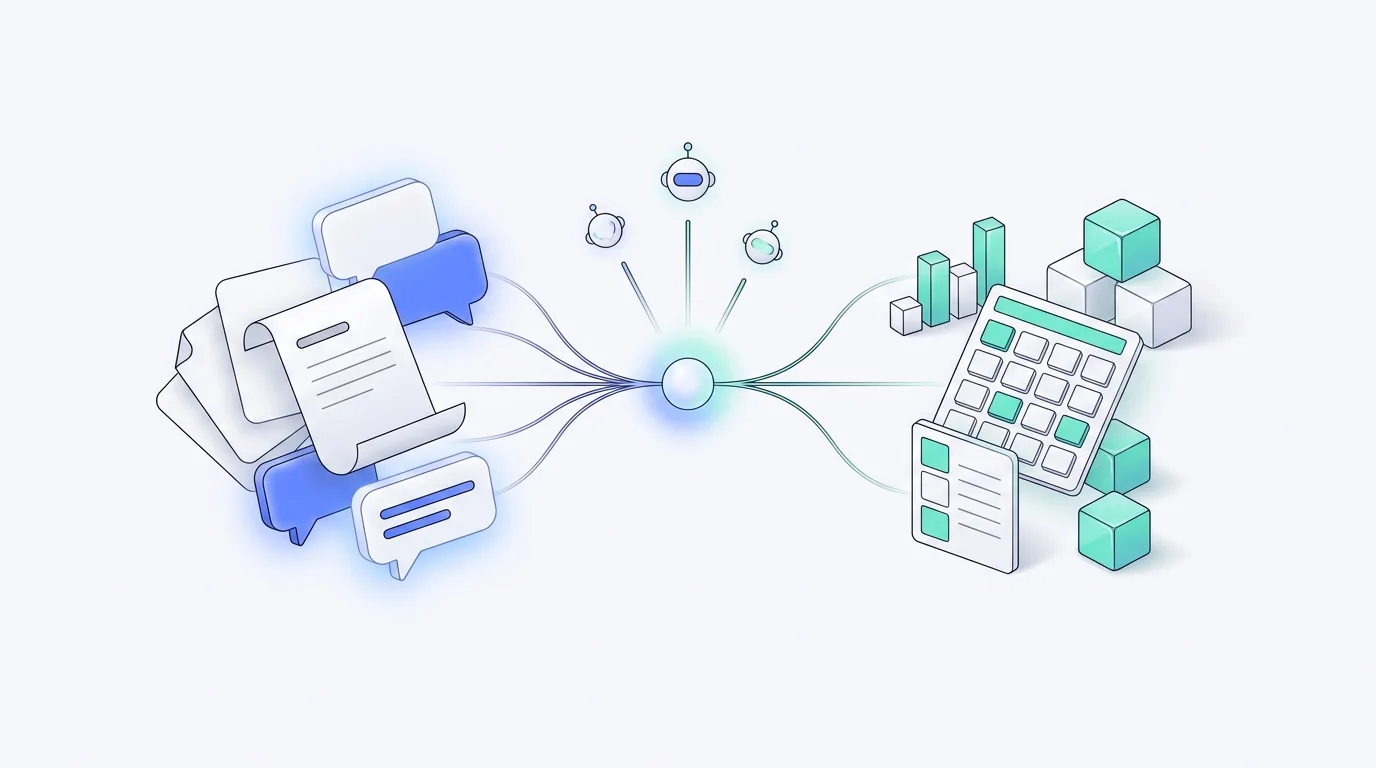
Most company-brain guides focus on documents, Slack threads, and meeting notes, which covers only half the job.
Picture two questions a sales leader might ask an AI agent on the same morning:
- "What did we promise Acme in the renewal call?"
- "What was net revenue retention for mid-market last quarter?"
The first is a knowledge question. The answer lives in text: a call transcript, an email, a CRM note. Finding the right passage and summarizing it works well.
The second is a numbers question. The answer is a calculation over records in your CRM, billing system, and product data. There is no paragraph to retrieve. Say the agent writes its own database query against raw tables. It has to guess which table holds revenue, how to treat downgrades, and what "mid-market" means. It may get a different answer every time.
So a working company brain has two halves:
- The knowledge half: docs, conversations, decisions, policies. Best served by search, wikis, RAG, and memory.
- The numbers half: metrics, entities, records. Best served by structured models: knowledge graphs, ontologies, and semantic layers over governed data.
Most of the trade-offs between the six approaches below come down to which half each one serves.
Six approaches to building a company brain#
| Approach | Example tools | Covers | Freshness | Governance | Build effort | MCP access |
|---|---|---|---|---|---|---|
| 1. Enterprise search | Glean, Microsoft 365 Copilot search | Knowledge half | Live connectors | Inherits app permissions | Low (buy) | Available in leading products |
| 2. AI wiki / knowledge management | Notion AI, Confluence with Rovo, Slite | Knowledge half | As fresh as people keep pages | Page-level | Low (buy) | Available in leading products |
| 3. DIY RAG on a vector database | Vector DB + embeddings + your own pipeline | Knowledge half | Depends on your sync jobs | You build it | High | You build it |
| 4. Knowledge graph + ontology | Graph databases, Palantir Foundry Ontology | Both halves, if modeled | Depends on your pipelines | Strong, by design | High | Varies |
| 5. AI memory layer | Sentra, Supermemory, cognee | Knowledge half, learned over time | Updates as agents work | Varies by product | Medium | Common |
| 6. Data platform + semantic layer + MCP | dbt Semantic Layer, Cube, RevOS | Numbers half | Scheduled data syncs | Strong: governed metrics | Medium (needs data pipelines in shape) | Built into some products, plan-dependent in others |
1. Enterprise search (Glean and similar)#
What it is. Enterprise search connects to your apps (Google Drive, Slack, Jira, Salesforce, Confluence) and builds one index across them. An AI assistant on top answers questions by retrieving the most relevant documents and messages. Glean is one of the best-known products in this category.
Strengths. Fast to roll out, because it uses content you already have. Respects the permissions of each source app. Good at "where is the doc about X?" and "summarize what we know about Y."
Where it breaks. Search finds text. It does not define your business terms or calculate metrics. If three dashboards show three different revenue numbers, search will happily find all three.
Best fit. Large companies with knowledge scattered across dozens of tools, where the main pain is finding things.
2. AI wiki and knowledge management (Notion AI, Confluence with Rovo)#
What it is. Your wiki or docs tool adds an AI assistant that answers questions from the pages you have written. Notion AI, Atlassian's Rovo on top of Confluence, and Slite all take this approach. This is the core of the "AI knowledge management" category.
Strengths. The content is curated. People wrote these pages on purpose, so quality is often higher than raw chat history. Easy to adopt if your team already lives in the wiki.
Where it breaks. It only knows what someone wrote down, and pages go stale. Atlassian's own research found that leaders and teams waste 25% of their time just searching for answers. That is a reminder that a wiki alone does not fix findability. (Atlassian sells Confluence, so read that figure as a vendor's survey.) Wikis also hold few live numbers.
Best fit. Teams with a strong documentation habit who want AI answers over their existing pages.
3. DIY RAG on a vector database#
What it is. You build the pipeline yourself. Documents are split into chunks and turned into embeddings, which are numeric representations of meaning. The embeddings go into a vector database. When a question comes in, the closest chunks are retrieved and the model answers from them.
Strengths. Full control over sources, models, cost, and where data lives. No vendor lock-in.
Where it breaks. Everything a product would handle is now yours: connectors, permissions, refresh jobs, chunking strategy, and evaluation. Retrieval by similarity is weak on numbers and on questions that span records. Many DIY efforts stall. Slite surveyed 149 teams, and of the teams that had tried to build their own company brain, 55% gave up. (Slite sells a competing product, and only part of that sample had tried a DIY build, so treat this as a signal.)
Best fit. Engineering-heavy teams with unusual data, strict hosting needs, or a product that needs RAG anyway.
For a deeper technical comparison of RAG with other ways to structure data, see our guide to how semantic models, knowledge graphs, and RAG compare as ways to structure data for agents.
4. Knowledge graph with an ontology#
What it is. You model your business as entities (customers, contracts, products, people) and the relationships between them. The ontology defines which entities and relationships are allowed. The knowledge graph stores the actual data. Palantir's Foundry, for example, is built around what it calls the Ontology, a model of an organization's objects and links.
Strengths. Structure helps AI accuracy on business questions. In 2023, researchers at data.world, a data catalog vendor built on knowledge graphs, tested GPT-4 on business questions. It answered 16% correctly when querying SQL tables directly, and 54% when the same data was modeled as a knowledge graph. The study is small, uses older models, and comes from a vendor that sells knowledge-graph tools. Still, it suggests that explicit structure helps more than asking a model to infer it.
Knowledge graph vs RAG. RAG retrieves text that looks similar to the question. A knowledge graph follows explicit links between records. So RAG suits "what does this document say?", while a graph suits "how does this customer connect to that contract and that support ticket?" Many teams use RAG for documents and a graph or semantic layer for connected records.
Where it breaks. Graphs are expensive to build and maintain. Someone has to design the ontology and keep it accurate as the business changes. That is a real ongoing cost, and it is overkill for simple lookups.
Best fit. Large organizations with complex, connected domains (supply chains, regulated industries) and the team to maintain an ontology.
5. AI memory layer#
What it is. Instead of indexing everything up front, a memory layer learns as agents and people work. It stores facts, preferences, and decisions from conversations and tasks, then feeds them back as context. Sentra, Supermemory, and the open-source cognee are examples.
Strengths. Memory layers target a gap that MIT NANDA's July 2025 report on enterprise AI, The GenAI Divide, described directly: "most GenAI systems do not retain feedback, adapt to context, or improve over time". (The report calls its findings preliminary.)
Where it breaks. Memory is only as good as what it captures, and it is hard to audit. When two conversations disagree, who decides which remembered "fact" is correct? Governance and permissions differ widely between products. Memory also does not calculate metrics.
Best fit. Teams running many agents on ongoing work, where carrying context between sessions matters most.
6. Data platform with a semantic layer and MCP#
What it is. This approach builds the numbers half. Data from your CRM, billing, and product systems flows into a warehouse. A semantic layer defines your metrics and entities once (revenue, churn, active customer), so every AI agent uses the same definitions. An MCP server exposes those governed definitions to any agent. When an agent asks for net revenue retention, it picks a defined metric. It does not write its own query from scratch. Tools in this space include the dbt Semantic Layer, Cube, and RevOS.
Strengths. Answers to numbers questions stay consistent. In 2026, dbt Labs compared its semantic layer with text-to-SQL, where the AI writes its own database query. With Claude Sonnet 4.6 and some light modeling, accuracy rose from 90.0% with text-to-SQL to 98.2% with the semantic layer. The authors noted a more useful difference: "With text-to-SQL, failure looks like a plausible but incorrect answer. With the Semantic Layer, failure looks like an error message." (dbt sells a semantic layer, and the test set is small.) For a company brain that difference matters, because an error gets noticed and a plausible wrong number usually doesn't.
Where it breaks. It does not read your docs, Slack, or meeting notes. It answers "what is true in our data?", not "what did we decide and why?" It also needs your data pipelines to be in shape. In a Harvard Business Review Analytic Services survey sponsored by Cloudera, only 7% of respondents said their organization's data was completely ready for AI.
Where RevOS fits. RevOS bundles this half into one managed platform. It syncs data from tools like HubSpot, Salesforce, and Stripe into a managed warehouse. It defines metrics once in a semantic layer (RevOS calls it the semantic model). A built-in MCP server for data then serves those metrics to Claude, ChatGPT, or Copilot, and to RevOS's own agents, which run natively in your Microsoft Teams or Slack. It sits next to enterprise search or your wiki rather than replacing them.
Best fit. B2B companies whose most important AI questions are about revenue, customers, and product usage, and who want those answers to match across every agent and dashboard.
What breaks in a company brain#
Keeping a company brain accurate after launch is harder than setting it up. In Slite's survey, only 19.6% of respondents said they have a company brain that works flawlessly. Slite itself calls that figure a ceiling. The survey also pointed to upkeep, not technology, as the main reason DIY builds were abandoned. The same failure modes show up in every approach:
- Stale content. Pages, embeddings, and memories age. Without owners and refresh jobs, the brain confidently repeats last year's pricing.
- Permissions that drift. An agent must not show salary data to someone who could not open the source file. Every approach needs to inherit or enforce source-system permissions.
- Conflicting definitions. If "active customer" means three things in three places, no amount of retrieval fixes it. Define it once, in an ontology or a semantic layer, and make every tool use that definition.
- No evaluation. Few teams test whether answers are correct. Keep a set of real questions with known answers and rerun them after every change.
- Siloed sources. Data that never reaches the brain cannot inform it. In the same HBR Analytic Services survey, the top obstacle to AI readiness, cited by 56% of respondents, was siloed data and difficulty integrating sources.
How to build a company brain: a practical setup#
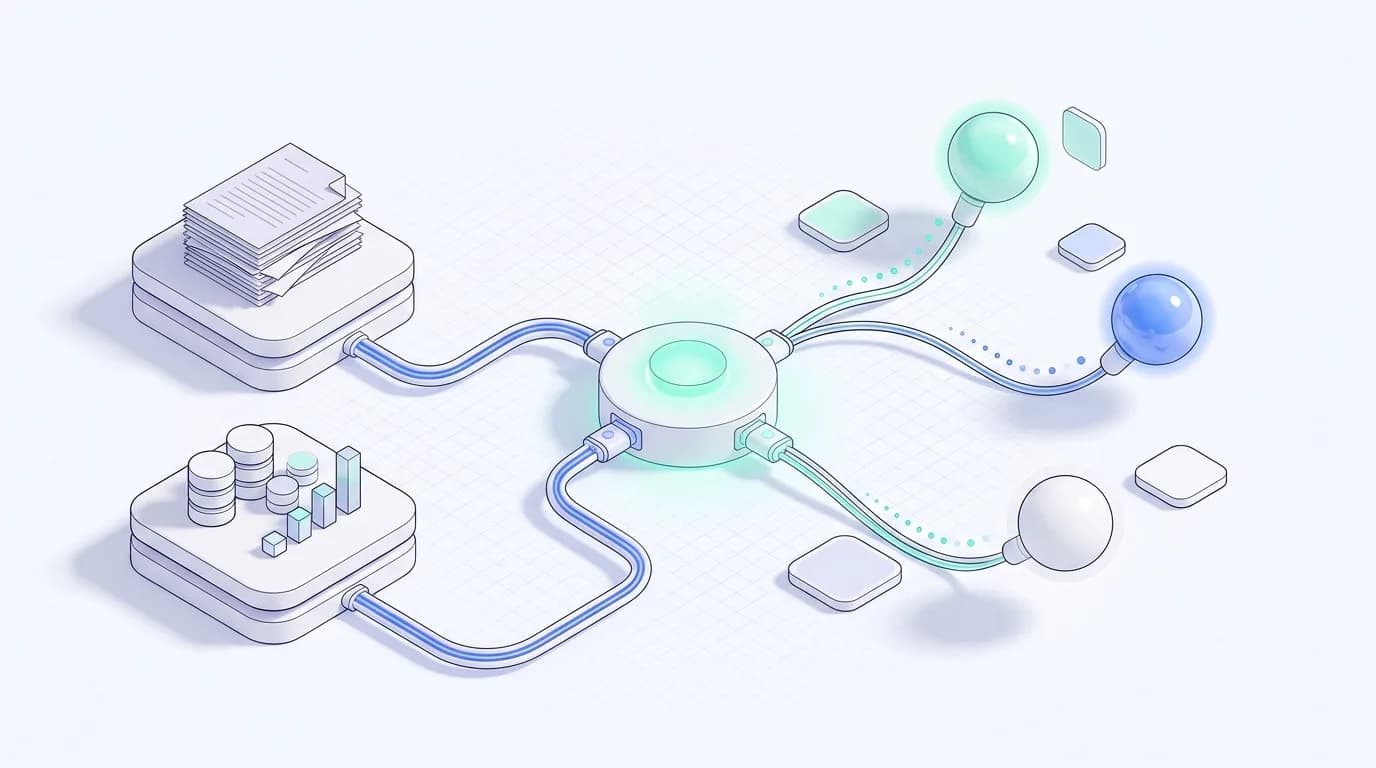
To build a company brain, list the questions it must answer. Then pick one tool for documents and decisions and one governed layer for business metrics. Define key terms once, and expose both through MCP so every agent reads the same context. Few products cover both halves well today, so most teams combine two.
- List the questions. Write down 30 real questions your teams and agents need answered. Sort them into knowledge questions and numbers questions. This tells you which half matters more.
- Pick a knowledge-half tool. If your content is spread across many apps, start with enterprise search such as Glean. If your team already writes good docs, use your wiki's AI, such as Notion AI or Rovo. Build RAG yourself only if you have a strong reason.
- Pick a numbers-half tool. Put your business data in one governed place and define key metrics and entities once, in a semantic layer or ontology. Options include the dbt Semantic Layer, Cube, or a bundled platform such as RevOS.
- Agree on definitions. Write down what "customer", "active", "churn", and "pipeline" mean. Use the same definitions in both halves.
- Connect everything through MCP. Expose both halves as MCP servers so Claude, ChatGPT, Copilot, and your own agents all read the same context.
- Set owners and tests. Give each source an owner. Rerun your question set on a schedule and after every change.
Start with one team and its questions, cover both halves for that team, and expand once the answers hold up.
Which company brain approach should you choose?#
Most teams will combine approaches rather than pick one. Search, wikis, RAG, and memory serve the knowledge half of a company brain. Knowledge graphs, ontologies, and semantic layers give the numbers half the structure it needs, and MCP connects both to the agents you run.
If your most important AI questions are about revenue, customers, and product usage, the numbers half is where to start. See how the RevOS semantic model gives every agent one governed view of your business data.
Frequently asked questions
- What is a company brain?
- A company brain is a shared context layer that holds what your company knows, so any AI agent or teammate can use it. It covers documents, conversations, decisions, definitions, and business data. Instead of each AI tool guessing from scratch, every agent draws on the same agreed context about how the business works.
- How do you build a company brain?
- List the questions it must answer. Use enterprise search, a wiki, or RAG for documents and decisions. Use a semantic layer or ontology over your business data for metrics. Define key terms once, enforce the same permissions as your source systems, and expose both halves to your AI agents through MCP. Then assign owners so the content stays current.
- What is the difference between a company brain and enterprise search?
- Enterprise search (for example Glean) indexes your existing apps and returns the most relevant documents and messages for a query. A company brain is broader. It is the full context layer an AI agent relies on, which can include a search index but also definitions, decisions, memory, and governed business metrics. Search is one way to build part of a company brain, not the whole thing.
- Is a company brain the same as a wiki or AI knowledge base?
- No. A wiki or AI knowledge base stores pages that people write, and an AI answers from those pages. A company brain uses that content as one source, but it also needs live business data, agreed definitions of terms, and permissions that follow your source systems. A wiki is one input to a company brain, not the whole brain.
- Is a company brain the same as a data catalog or semantic layer?
- No. A data catalog lists your tables and who owns them, but it does not answer business questions. A semantic layer defines business metrics such as revenue and churn once, so every tool calculates them the same way. A semantic layer is one part of a company brain, the part that covers numbers. The brain also needs the knowledge half: documents, conversations, and decisions.
- What is the difference between a company brain and RAG?
- RAG (retrieval-augmented generation) is a technique: it finds text passages that match a question and hands them to an AI model. A company brain is the whole context layer. Many company brains use RAG to serve documents, but RAG alone does not define business terms, calculate metrics, or manage permissions.
- What is a context layer?
- A context layer supplies the business context an AI model needs to give correct, company-specific answers. That includes what terms mean, how metrics are calculated, who can see what, and what was decided. Context layer and company brain describe the same idea. Context layer is the more technical name.
- What is the difference between a knowledge graph and an ontology?
- An ontology is the schema. It defines the types of things in your business (customer, contract, product), their properties, and how they may relate. A knowledge graph is the data: the actual customers, contracts, and products stored as connected nodes that follow that schema. The ontology keeps the graph consistent as it grows.
- What is an ontology in AI?
- In AI, an ontology is a formal definition of the concepts in a domain and the relationships between them. It gives a model an agreed vocabulary, so account, customer, and logo are not treated as three unrelated things. Ontologies underpin knowledge graphs and are closely related to semantic layers, which define business metrics in a similar governed way.
- Knowledge graph vs RAG: which is better for a company brain?
- RAG retrieves text passages that look similar to a question. It is quick to set up and works well for documents. A knowledge graph stores explicit entities and relationships, so it handles questions that follow connections across records. In a small 2023 benchmark by researchers at data.world, a knowledge-graph data catalog vendor, GPT-4 answered 16% of business questions correctly against raw SQL tables and 54% when the same data was modeled as a knowledge graph. Many teams use RAG for documents and structured models for data.
- What is the difference between a semantic layer and a context layer?
- A semantic layer defines business metrics and entities (revenue, churn, active customer) once, on top of your data warehouse, so every tool calculates them the same way. A context layer is the broader idea of everything an AI agent needs to know about your business. A semantic layer is the part of the context layer that covers numbers.
- Is there an open-source company brain?
- Not as a finished product, but there are open-source building blocks: vector databases for RAG, memory frameworks such as cognee (open source) and Supermemory (open core), and graph databases for knowledge graphs. You still own connectors, permissions, data freshness, and evaluation.
- How does a company brain connect to Claude or ChatGPT?
- Through MCP (Model Context Protocol), the open standard for connecting AI assistants to external tools and data. Glean, Notion, Atlassian Rovo, and several memory and data platforms now offer MCP servers. Once your company brain runs one, Claude, ChatGPT, Copilot, or a custom agent can query it without a custom integration for each tool.
Read more about revenue operations, growth strategies, and metrics in our blog and follow us on LinkedIn and Youtube.
All articles