Customer Health Scoring update 2025
Renat ZubayrovLast year, our Customer Health Score Template was an enormous success, with thousands of downloads globally and widespread daily usage across various industries. Thanks to an overwhelming wave of feedback and an extensive evaluation of tens of millions of data points collected on the RevOS platform over the past year, we're thrilled to roll out our most exciting and advanced update to the Customer Health Score Template yet.
Incorporating over 450 community-driven suggestions and enhancements inspired by top-tier organizations like Apple, IBM, Google, and Wolterskluwer, this latest version offers simplified setup, enhanced customization, and more robust predictive capabilities, enabling businesses to proactively manage customer success more effectively than ever.
Latest version features a simplified setup, enhanced customization, and more robust predictive capabilities, enabling businesses to proactively manage customer success more effectively than ever.
2025 Trends and Recommendations for Customer Health Scoring
Before diving into the specifics of the 2025 updates, it's valuable to highlight some key learnings and emerging trends we've observed in predictive scoring.
To begin, high-quality data remains paramount. Companies and teams that diligently maintain accurate, consistent, and timely data in their CRM systems are significantly better positioned to make effective, data-driven decisions. Quality data not only enhances predictive accuracy but also enables proactive strategies, giving businesses a competitive advantage.
It's crucial to ensure your customer health score drives actionable insights. Many health scores fail because they're disconnected from meaningful actions. Selecting KPIs should always involve asking, "What specific actions can we take to impact this KPI?" ensuring that your scores remain practical, relevant, and effective.
Ensuring relevance involves carefully aligning customer health scores with tangible business outcomes. Many health scores fail to deliver expected results because they're not closely connected to actual business objectives, reducing their effectiveness and negatively impacting the return on investment. By clearly linking health scores to critical business metrics like growth, profitability, and customer satisfaction, businesses can ensure their activities have a meaningful impact, maximizing strategic value and ROI.
A well-constructed health score is validated through historical data, grounded in the past experiences of your team, and proven through past performance. For example, consistently declining product usage patterns historically predict higher churn rates, while frequent engagement with support resources can indicate an emerging issue that proactive measures could resolve. Historical data validation not only strengthens reliability but enhances predictability, making your health scores a trustworthy guide for future strategic decisions.
Simplicity is essential for effective health scoring. Often, teams create overly specific or complicated scoring models that are difficult to communicate and understand, much like 'over-fitting' in machine learning. A simpler approach, starting with 6 to 10 carefully selected KPIs grouped into 2-3 intuitive categories, generally provides greater clarity, usability, and effectiveness. This streamlined method makes the health score easier to interpret, implement, and refine over time, ensuring better alignment and adoption across teams.
Deep Dive into Updated Template Sections
Overview Page / Dashboard
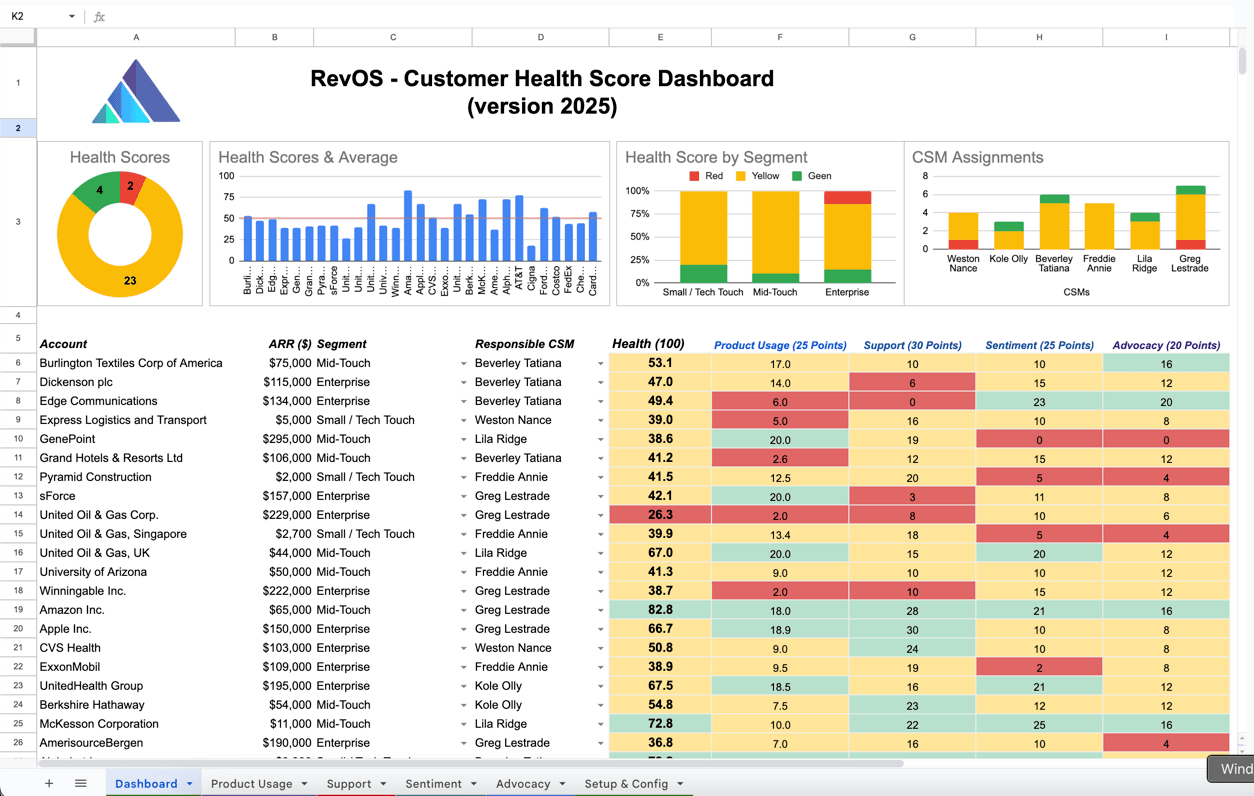
The Overview Page serves as the central hub for tracking customer health, consolidating insights from all four scoring categories—Product Usage, Support, Sentiment, and Advocacy—into a single, actionable metric. This dashboard enables teams to quickly assess overall customer engagement, identify risks, and prioritize accounts for intervention.

Dashboard details
- Comprehensive Customer Health Score (Max 100 Points)
- Each account receives an aggregated Customer Health Score based on the four core scoring components: Product Usage (25 Points), Support (30 Points), Sentiment (25 Points) and Advocacy (20 Points)
- This ensures a balanced view of customer health, reflecting both adoption trends and relationship strength.
- Segmented Analysis for Targeted Strategies
- Customers are categorized into Small/Tech Touch, Mid-Touch, and Enterprise segments, allowing for tailored engagement strategies.
- Health scores are visually represented in green (healthy), yellow (neutral), and red (at risk), making it easy to prioritize accounts needing attention.
- CSM Assignments and Workload Distribution
- The dashboard provides a breakdown of Customer Success Manager (CSM) assignments, ensuring even workload distribution.
- Helps leadership teams monitor CSM performance and adjust account distribution as needed.
Product Usage
Understanding how customers engage with your product is essential for proactive customer success management. Product usage scoring allows businesses to assess adoption levels objectively, regardless of company size, by normalizing key metrics.

Why Product Usage Matters
- Utilization Reflects True Engagement
- Companies differ in size, making raw usage numbers misleading. To ensure fairness, we measure monthly active users relative to total licenses/seats, creating a normalized utilization score that accurately represents product adoption.
- Feature Adoption Indicates Value Realization
- Not all product features contribute equally to success. Core functionalities hold greater strategic importance, so their impact on scoring is weighted accordingly. This ensures businesses focus on the most valuable adoption trends.
- Integrations Drive Stickiness
- Deeper product integration into a company’s tech stack reduces churn risk. Our scoring reflects this by assigning higher importance to customers with multiple active integrations, recognizing them as more embedded and engaged users.
Support
A strong support experience is a key pillar of customer success, ensuring that users receive timely and effective resolutions to their issues. The updated Support Scoring methodology evaluates customer interactions based on two fundamental groups of KPIs: Resolution Efficiency and Tickets Stats, while also accounting for escalations as a negative factor.

Why Support Scoring Matters
- Resolution Efficiency Measures Support Quality
- This group includes Median Time to First Reply, Median Full Resolution Time, and First Contact Resolution Rate. These metrics are normalized to industry standards, ensuring fair comparisons across different businesses.
- Faster response and resolution times improve customer satisfaction, while higher first-contact resolution rates indicate effective issue handling.
- For deeper insights, trends can also be analyzed over time, highlighting improvements or emerging risks. This advanced feature is available in RevOS.
- Ticket Stats Identify Support Demand & Risk
- Includes High & Urgent Tickets, Other Tickets, and Tickets Resolved Last Week.
- A high volume of unresolved tickets may indicate product issues, while efficient resolution boosts customer trust.
- Businesses can use these insights to optimize workload management and resource allocation.
- Escalation Markers Highlight Critical Issues
- If a ticket requires escalation to a decision-maker, it signals unresolved concerns and potential dissatisfaction.
- Escalations do not contribute points but instead deduct from the final score, emphasizing their negative impact on customer experience.
Sentiment
Understanding customer sentiment is crucial for long-term success. The updated Sentiment Scoring model evaluates how engaged and connected customers are with your business, ensuring a proactive approach to relationship management. This score is built from three key components: Customer Contacts, QBR Engagement, and Escalation Impact.

Why Sentiment Scoring Matters
- Customer Contacts Reflect Relationship Strength
- Knowing the key users and decision-makers within a company is essential for driving adoption and retention.
- Customers with well-established points of contact score higher, as they indicate stronger engagement and alignment.
- QBR Engagement Shows Long-Term Interest
- Participation in Quarterly Business Reviews (QBRs) is a strong indicator of a customer’s ongoing commitment.
- If a decision-maker attends QBRs, it further reinforces strategic alignment and future growth potential.
- Escalation Signals Dissatisfaction
- Escalations deduct 20 points but don’t contribute positively. However, even with deductions, the total score cannot fall below zero, ensuring a balanced evaluation.
- They indicate unresolved concerns that may lead to churn if not addressed.
Advocacy
Advocacy is a strong indicator of customer commitment and long-term satisfaction. This scoring model measures how actively customers promote your product and engage with your brand. It consists of two key components: Market Presence and Customer Engagement.

Why Advocacy Scoring Matters
- Market Presence Reflects External Influence
- Customers who contribute to public case studies, leave reviews on G2 or Capterra, and share their experiences help strengthen brand credibility.
- Each of these activities contributes to the Market Presence score, with higher participation leading to a stronger advocacy profile.
- Customer Engagement Shows Ongoing Interest
- Customers who participate in reference calls and webinars demonstrate continued investment in the product.
- Unlike static data points, webinar participation is time-sensitive.
- The score considers how recently a customer attended a webinar:
Next Steps:
Download the Updated Template and Explore Automated Insights
- Simple steps to download and start using the updated template immediately
- Benefits of transitioning from manual to automated health scoring
- Introduction to our app with automatic data connectivity, real-time updates, and actionable insights
Encourage readers to download the new template and explore our automated customer health scoring app
- Offer a free trial/demo to experience automation firsthand
- Invite readers to share feedback for ongoing improvements
Read more about revenue operations, growth strategies, and metrics in our blog and follow us on LinkedIn, Youtube, and Facebook.
← Go back to blog