

On this page
Every company today wants to be an AI company, racing to adopt the latest AI trends. Leaders are pushing for predictive churn models, generative agents for customer success, and automated forecasting. But there is a silent killer stalling these initiatives before they even launch: The Data Mess.
Most data platforms don’t fail because of the tooling. They stall because raw, messy inputs are rushed straight into analytics, teams patch problems locally in spreadsheets, and every dashboard bakes in a different "truth".
At RevOS, we believe that without a deliberate data strategy, your revenue operations are paying a hidden tax on speed, trust, and outcomes.
In this four-part series, we are going to break down how to build a data foundation that actually works. We will eventually cover specific implementation paths—using Microsoft Fabric, Databricks, or an Open Source DIY approach - but first, we must establish the strategy.
Here is why you need to stop chasing tools and start designing your data architecture.
Want the deeper walkthrough? Watch the on-demand webinar Turn Data Silos into Trusted AI-Ready Data Products for a step-by-step look at fixing this before it derails your AI roadmap.
The High Cost of the "Copy-Storm"#
The current state of data in many scaling SaaS companies is defined by silos. Marketing has their extracts, Sales has Salesforce reports, and Finance has their spreadsheets.
When these teams try to collaborate, they run into the "Copy-storm" anti-pattern. Datasets are replicated across multiple workspaces "for convenience," severing lineage and inflating costs. The result?
- Trust Deficit: If revenue shows three different numbers across three different departments, the only thing everyone agrees on is to question the dashboard.
- Operational Drag: Every new initiative begins by re-creating the same data pipelines, stretching time-to-value from weeks to quarters.
- AI Hallucinations: AI models trained on inconsistent inputs behave unpredictably. If your data foundation isn't grounded, your AI agents will hallucinate, not help. That grounding is exactly what separates a demo from a system you can trust — see our deep dive on agentic data engineering for how that trust actually gets built.
Research suggests that:
80% of business leaders don’t trust their data because it is scattered and poorly managed.
You cannot build a revenue engine on shaky ground.
The Strategic Fix: The Medallion Architecture#
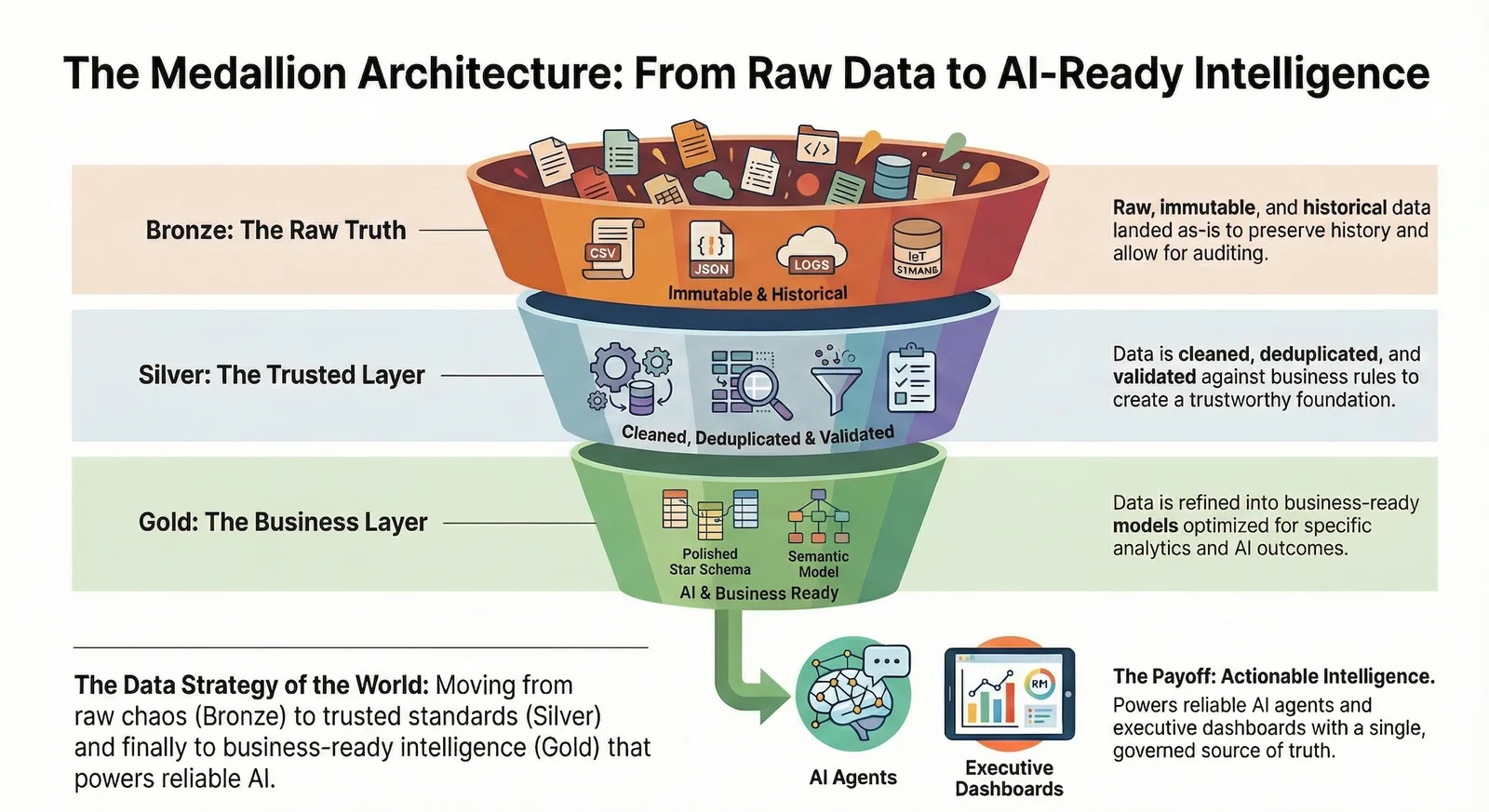
To fix this, we advocate for a data strategy based on the Medallion Architecture. While often described as a technical pattern, it is actually an operating model for managing complexity at scale.
It forces a separation of concerns that turns a sprawling set of pipelines into a system with clear roles:
- Bronze (The Raw Truth): This is where data arrives as-is. It is immutable and preserves history. If you need to audit what happened, you go here.
- Silver (The Trusted Layer): This is where "data from Salesforce" becomes "data fit for business use". Here, we de-duplicate, standardize types, and enforce business rules. Crucially, changes here should be additive only—we never break the API promised to downstream users by deleting columns they rely on.
- Gold (The Business Layer): This is the curated zone. Data here is aligned to specific outcomes—like Gross Margin or Churn Risk—so analytics and AI lean on shared, governed definitions.
By adopting this structure, you ensure that Silver guarantees trust, while Gold guarantees alignment with business outcomes.
The Business Case: Why Do This Now?#
Implementing a structured data strategy isn't just about "cleaner tables." It is about Revenue Productivity.
1. The "Single Source of Truth" is No Longer Optional A unified semantic layer ensures that core business concepts are defined once and reused everywhere. This eliminates the variance caused by one-off transformations inside individual reports.
2. AI Readiness Your data needs to be ready for machine learning. A well-governed Gold layer shortens the last mile for ML and LLM features without turning your platform inside out. It allows you to move from noisy data to confident, real-time decisions.
3. Cost and Risk Control - Uncurated, compute-heavy transformations that multiply across tools are a financial drain. A structured approach allows you to control costs by running heavy transforms once per layer, rather than re-wrangling data for every specific query. Furthermore, governance becomes embedded in the architecture, allowing for automated lineage tracking and "Just-Enough-Access" security policies.
The Business Case: The Actual Numbers#
When data is siloed, you aren't just losing visibility; you are losing money. Based on recent strategy assessments of mid-market SaaS organization, we have quantified the financial impact of shifting from chaotic silos to a governed Medallion Architecture.
Here is what that impact looks like on the P&L:
1. Unlocking "Hidden" Revenue (Top-Line Growth) Most SaaS companies sit on a goldmine of cross-sell opportunities they simply cannot see because product usage data is disconnected from CRM data. By unifying these sources into a "Gold" layer, the revenue implications are immediate:
- The "Wallet Share" Gap: In a portfolio analysis of 1.5M active users, unifying usage data with billing records allowed the company to detect subtle wallet-share declines before the contract renewal. Predictive intervention here was projected to reduce churn by 1%, protecting an estimated mid-5-digits in monthly recurring revenue (MRR).
- Targeted Expansion: Instead of "spray and pray" marketing, a unified data estate allowed for an outbound campaign targeting 1,000 specific customers based on actual feature usage gaps. With a conservative 10% opportunity rate and a moderate uplift, this single data-driven play generated high-four-digits net new MRR immediately.
- The RevOS Impact: Organizations that align their commercial architecture in this way typically see 19% faster growth and an 18% increase in Net Revenue Retention (NRR).
2. Eliminating the "Manual Tax" on Talent (Bottom-Line Efficiency) Data silos force high-value employees to do low-value work. Without a "Silver" layer to standardize data, your most expensive resources waste time wrangling spreadsheets.
- Sales Productivity: When Sales Reps have to manually cross-reference billing systems to check for upsell eligibility, they lose selling time. Our research indicates that automating these insights saves 10% of each Sales Rep’s time, effectively unlocking 2 full-time employees (FTEs) of productivity in a 20-person team.
- Engineering Waste: We frequently see engineering teams bogged down by ad-hoc data requests from the business (e.g., "Can you run a query to see who used feature X?"). In one case study, automating self-service reporting eliminated 500 manual requests per year. At 2 hours per request, that is 1,000 hours (0.5 FTE) of engineering time returned to product development.
3. Innovation and New Business Models A structured data platform doesn't just optimize existing processes; it creates new products.
- Monetization: Once your data is structured and governed in a Gold layer, it becomes a product in itself. Companies are successfully launching Usage-based API monetization strategies, selling data insights back to their customers as a premium tier—a business model impossible to execute with fragmented data. That same governed Gold layer is the foundation of what's now being called token capital — a proprietary AI asset a company owns, not just spend on.
- AI Readiness: You cannot build a "Revenue Brain" on shaky ground. A reliable Gold layer allows you to deploy AI agents that can answer complex financial questions without hallucinating, driving pipeline velocity up by 25%. That Gold layer is also the prerequisite for enterprise AI agent deployments — without it, even the most capable agent returns unreliable answers. The connection itself usually runs over an MCP server — in practice, an MCP server for data fronted by your semantic model — so the agent queries governed metrics by name instead of guessing at raw tables.
4. The Cost of Risk The most expensive data problem is the one that lands you in legal trouble.
- Compliance & Trust: Manual data exports are a security nightmare. We have observed cases where manual CSV handling led to data from the wrong customer being sent to an external party. A governed architecture with automated Row-Level Security (RLS) and sensitivity labels prevents this physically, ensuring compliance with strict regulations like the EU Data Act.
The Verdict: You don't need magic to grow. You need your revenue team to see who is using the product, your Engineers to stop writing ad-hoc SQL, and your AI to stop guessing. That requires a strategy.
What’s Next?#
A strategy is only as good as its execution. Over the next three posts in this series, we will dive deep into the technical implementation of this strategy across three different stacks:
- Microsoft Fabric: How to leverage OneLake and Direct Lake mode for a unified SaaS experience where you don't need to move data.
- Databricks: Building a Lakehouse with deep engineering control.
- Open Source DIY: Managing the complexity yourself for maximum flexibility.
Building a Medallion Architecture is a journey, but you don’t have to walk it alone.
Schedule a call with a RevOS expert and get direct insights from our recent implementation projects and discuss how to apply the "Data Strategy of the World" to your specific revenue challenges.
Don’t miss the deep dives. Follow us on LinkedIn to get notified immediately when the implementation guides for Fabric, Databricks, and Open Source go live.
Read more about revenue operations, growth strategies, and metrics in our blog and follow us on LinkedIn and Youtube.
All articles